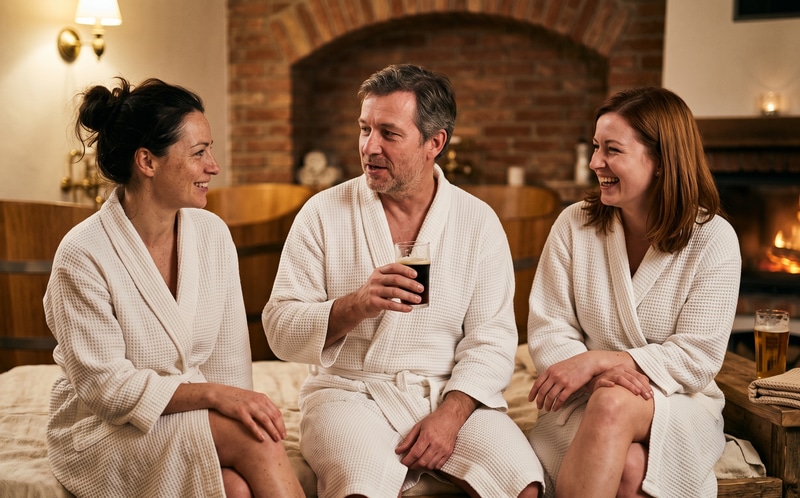
Why HR looks for a partner, not a one-off perk
Corporate wellness is no longer about handing out vouchers and hoping people remember to use them. For HR, the real question is whether a benefit fits the company culture, can be managed without friction and delivers genuine value both to employees and to the budget behind it. That is why long-term partnerships are becoming more relevant than occasional, ad hoc bookings. Research into workplace wellness consistently points to more than simple ROI. Employers increasingly look at VOI too - value on investment in the form of engagement, morale and a healthier working atmosphere. In practice, that means a worthwhile partner should offer more than a service. It should come with a straightforward process, clear reporting and enough flexibility to suit different teams and different moments in the company calendar.
That is exactly where a corporate partnership with Lázně Pramen starts to make sense. An HR team can use a visit as a small-scale team-building evening, a reward after a demanding quarter or a polished year-end gift. At the same time, the company joins the partner program and receives a 10% commission on every confirmed booking. That commission is paid monthly, with no entry fee and no minimum volume. Put simply, the more employees or teams use the benefit, the more of the spend can flow back into the next cycle of employee rewards. For HR, that is a far more compelling model than buying a one-off benefit with no feedback loop attached.
Just as importantly, the setup is not burdened by a heavy rollout. Onboarding happens in three steps - register, share the link, earn. Once registered, the company receives a personal QR code, its own referral link and access to a self-service partner dashboard with real-time tracking. There is also a dedicated account manager - an actual point of contact who can help shape the collaboration from the outset. If you want to get a feel for the visit options first, start with the overview on the procedures page and then discuss the details via contact.
What a strong B2B wellness partnership looks like
A good B2B spa partnership is not defined by a polished deck. You notice it in the day-to-day reality of using it. HR needs a partner that understands the difference between a reward for one person, a shared team activity and a refined gift for senior leadership. Expert commentary on corporate well-being partnerships tends to highlight three essentials: alignment with organisational goals, a seamless user experience and benefits that genuinely matter to employees. In company life, that translates into light administration, clear booking rules and an offer broad enough to work across job functions, age groups and expectations.
At Lázně Pramen, the advantage lies in how flexibly the partnership can be used. One month, HR might send a project team to a private beer spa. Another, it may book a more polished wine spa as a gift for a manager or an important client. For businesses, it matters that this is not an anonymous marketplace but a direct collaboration with practical tools attached. A personal QR code can be added to an internal newsletter, the referral link can sit in the intranet or benefits platform, and the real-time dashboard shows exactly how many bookings have actually gone through.
The strongest corporate wellness partners also share another quality: they are measurable without feeling transactional. HR does not just need a spreadsheet. It needs an experience employees perceive as a reward rather than an obligation. That is where a private setting, clearly defined capacities and a straightforward flow through booking become important. And if a company is not ready to launch a large internal campaign from day one, the partnership can be introduced gradually - with no entry fee and no minimum booking volume. That sort of flexibility is precisely what a modern wellness business partnership should offer.
How to plan team visits for 4 to 8 guests
For HR, capacity is not a minor detail. It is one of the first practical questions that determines whether an experience can actually work for a given team. In Dejvice, a single time slot can accommodate 4 to 8 guests across private spa rooms. More specifically, 4 guests can be hosted in Zlatý pramen, 2 in Rubínový pramen and 2 in Smaragdový pramen. That setup is particularly useful for a department gathering, a smaller leadership group or a reward after a major project milestone. For groups above 8, the realistic solution is to split the visit into two time slots - for example 17:00 and 19:00 - rather than pretend everyone can fit in at once.
The most workable scenarios tend to look like this:
- a team of 4 - the full program in Zlatý pramen, where two tubs can run at the same time
- a team of 6 - 4 guests in Zlatý pramen and 2 guests in Rubínový pramen
- a team of 8 - full capacity: 4 in Zlatý pramen, 2 in Rubínový pramen and 2 in Smaragdový pramen
- senior leadership or a key guest - a separate V.I.P. program in Smaragdový pramen
That ability to combine formats matters enormously for HR. In a single evening, a company can reward a wider team while keeping a more elevated experience separate for executive level guests. The V.I.P. programs are strictly designed for 1 to 2 guests, which makes them well suited to directors, founders, business partners or a highly personal gift. Standard spa rooms, meanwhile, are the natural fit for regular group visits, with the option to follow up in Safírový pramen, where massages and other quieter treatments take place.
Which treatments work best for corporate use
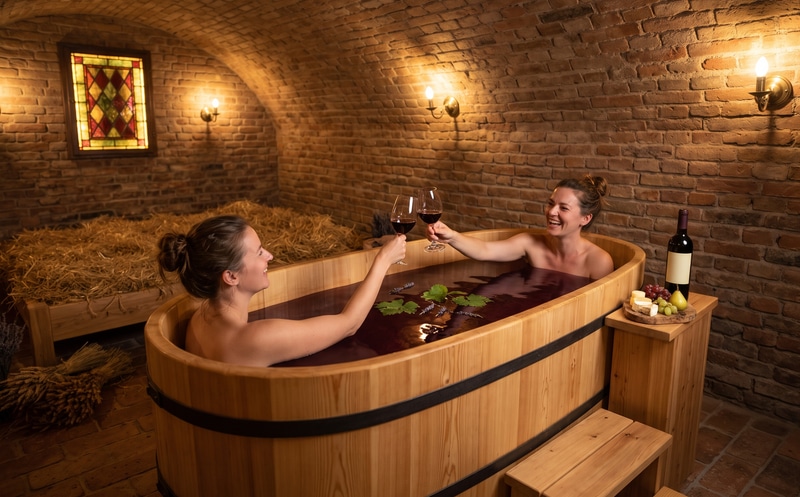
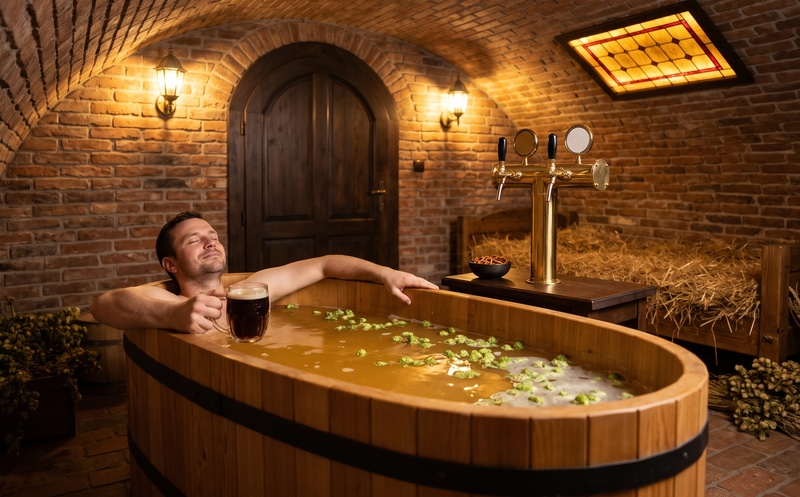
Corporate clients rarely want the biggest possible menu. What they usually need are clear, usable formats that are easy to position internally. That is one of the strengths of the offer at Lázně Pramen. For a pair, or as a smaller reward for an individual, the beer spa works particularly well, starting from €148 per room - meaning the whole reservation, not per person. The same pricing logic applies when two people share one tub. If the company wants something more polished, the wine spa in one tub starts from €201 per room and includes a bottle of wine in the room. It is a smart choice as a reward for an employee and partner, or as a well-judged gift for a client.
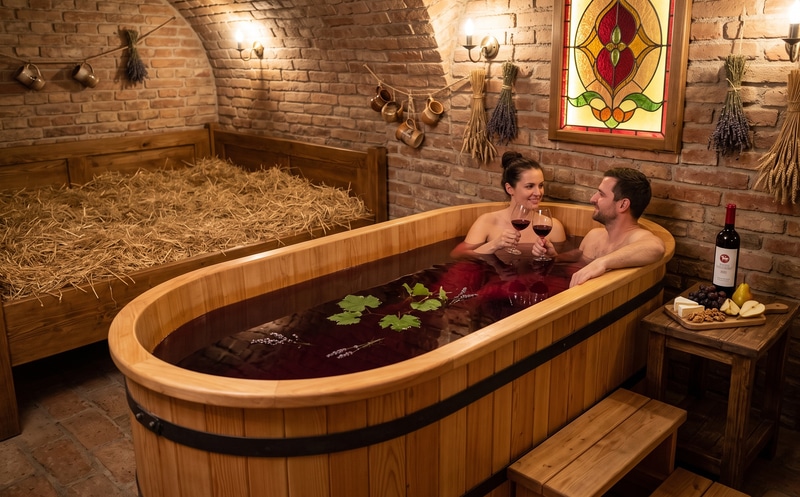
For smaller teams, the key setup is in Zlatý pramen, where two tubs can run simultaneously. Two beer spa tubs start from €190 per booking for 2 to 4 guests, two wine spa tubs from €268 per booking, and the beer-plus-wine option from €238 per booking. From a corporate point of view, the combo treatment is especially useful because it gives each guest a choice without forcing the whole group into one format. One person may prefer the traditional hop and malt ritual, another may be more drawn to grapes, honey and lavender. The result is a shared experience that does not feel unnecessarily uniform.
For executive-level gifting, the focus shifts to Smaragdový pramen. The V.I.P. Beer SPA starts from €293 per booking and the V.I.P. Wine SPA from €326 per booking, in each case for 1 to 2 guests. That distinction is worth making internally as well: this is not a group package but a premium format intended for leadership, top performers or guests where detail matters. Combined with a team visit in the standard spa rooms, it gives HR a neatly tiered benefit structure - from broadly accessible reward to genuinely representative experience. You can see the full range on the procedures page.
How the 10% commission feeds back into the benefits budget
For many HR teams, the most interesting part of a corporate partnership is the financial logic behind it. A conventional employee benefit is usually a pure cost. A partner model, by contrast, can return part of that spend. At Lázně Pramen, the structure is simple: 10% commission on every confirmed booking. Payouts are made monthly, with no minimum volume and no entry fee. That means a company testing the waters with only a handful of bookings a year gets the same access to the system as a higher-volume partner. From an HR perspective, it lowers the barrier to entry and makes it easier to trial the benefit with a smaller sample of teams before scaling it up.
The model becomes very clear with a concrete example. If a company recommends the combo treatment for 2 to 4 guests from €238 per booking, a 10% commission means roughly €23.80 coming back. Rounded, you can think of a reservation at around €240 returning about €24 into the budget. If ten similar bookings happen over the pre-Christmas period, HR or the benefits budget recovers approximately €240. At that point, it is no longer a token amount. It is a practical sum that can help fund the next internal campaign, staff competition or an additional layer of employee rewards.
This approach sits neatly within the broader conversation around ROI and VOI in wellness programs. The value is not only in direct return, but in the fact that the benefit strengthens the employee relationship with the company while remaining measurable. The partner dashboard with real-time tracking gives HR an immediate view of how many bookings came through a personal QR code or a dedicated referral link. And a dedicated account manager can help shape the communication strategy - whether the benefit is best positioned as a performance reward, a Christmas gift or an ongoing part of employer branding. If you would rather start by testing a single visit, the easiest route is through booking.
A practical scenario: year-end rewards without cheap gifts
Imagine a mid-sized company in Prague with 55 employees and a lean HR team. As the year closes, it faces a familiar problem: how to reward people in a way that feels considered rather than routine. Instead of defaulting to generic gift boxes, the company chooses a two-track model. Project teams of four to six are sent for evening visits to Zlatý pramen and Rubínový pramen, while two members of senior leadership and an important external partner are booked separately into Smaragdový pramen for a V.I.P. program. Organisationally, the result is clean. The wider team gets a shared experience, leadership receives a more representative format, and HR does not need to justify why everyone was given exactly the same thing regardless of context.
In practice, one evening wave can host up to 8 guests. The company therefore spreads the December program across several dates and shares its personal QR code and referral link through the internal benefits newsletter. Employees can then book visits independently or use the company recommendation for a private date of their own. Every confirmed booking appears in the self-service dashboard in real time, so HR sees actual demand rather than a rough estimate. The monthly commission payout then returns 10% of confirmed bookings to the company. By January, the budget is not restarting from zero, but with a portion of funds the benefit has helped generate itself.
There is another reason this scenario works well: the benefit is tangible. Employees know where they are going, what to expect and how long the treatment lasts. In the standard spa rooms, the experience runs for around 90 minutes. In the V.I.P. programs, it lasts 2.5 to 3 hours. That clarity tends to increase both trust and participation. If the company wants to broaden the offer further, it can add massages in the salt cave as a separate visit for individuals who prefer a quieter format to a team evening.
Who the partner program is designed for
Although this article is written primarily with corporate HR benefits in mind, the partner program has a broader reach - and that breadth is part of its appeal. Publicly, it is designed for hotels and guesthouses, guides and travel agencies, corporate HR programs, bloggers and influencers, as well as concierge services. For HR teams, that matters. You are not entering a narrow, isolated system, but a partner model built to support several types of referring relationship. In most cases, that means a sturdier process, clearer reporting and better readiness for different use cases - from internal employee benefits to gifts for international visitors or business partners.
In practice, a company can use that flexibility in several ways at once. HR may place the referral link in the intranet, the office manager may print the QR code for reception, and the sales team may offer selected clients a private wine spa or beer spa as a polished add-on during a visit to Prague. That modularity is exactly what companies expect from a wellness business partnership when they do not want a different supplier for every separate purpose. One partner, multiple uses, one set of booking records.
There is also very little upfront risk. There is no upfront fee and no minimum volume. A company does not need to sign itself into a large commitment before finding out whether the benefit actually resonates with employees. It can begin with a pilot, review uptake and then expand the collaboration only if the response justifies it. That is a sensible approach at a time when businesses are watching costs more closely, but are not willing to compromise on the quality of the employee experience. If you want a broader sense of the possibilities, there is more inspiration on the blog.
How to launch the partnership without unnecessary admin
One of the main reasons corporate benefits fail to gain traction is not price, but process friction. Too many steps, vague approvals, clumsy communication. That is why a simple operating model matters. In this partner program, onboarding has three steps: register, share the link, earn. The simplicity is backed by practical mechanics. Once registered, you receive a personal QR code, your own referral link and access to a self-service dashboard showing performance in real time. For HR, that is exactly the kind of operational clarity that makes a benefit workable rather than aspirational.
A sensible launch can be surprisingly straightforward. First, define the purpose internally: team-building, a reward after a major deadline, a Christmas gift or a benefit for leadership. Then test one or two formats - for example the combo treatment for a smaller team and a separate V.I.P. experience in Smaragdový pramen for executive level guests. After that, communicate the benefit through internal channels using the QR code or referral link. The dashboard will show in real time what is actually working. And if you need advice on messaging or on how best to distribute capacity, a dedicated account manager is there to help.
Timing matters as well. For the corporate segment, year-end is an obvious strong period, but spring and autumn also work particularly well, when teams tend to feel the drag of intense working stretches. Research into workplace wellness also suggests that visible employer support increases the likelihood that employees will actually use the programs available to them. When a benefit is not buried in a catalogue but actively recommended and logistically easy to access, uptake rises. That is the difference between a benefit that exists on paper and one that people genuinely use.
When to start and where to click next
If you work in HR, the best time to start a partnership is usually earlier than you think - ideally before peak season begins. Once year-end approaches, dates for corporate rewards fill quickly, and the companies that see the strongest results are usually the ones that have prepared the benefit in advance. With Lázně Pramen, the key advantage is that you can begin with a small pilot, with no entry fee and no minimum volume. One team, one executive gift, one internal campaign built around a QR code. Then expand only in line with real interest. That makes the model just as suitable for smaller firms as for larger organisations that want to test employee response before committing more broadly.
From an offer perspective, the decision-making is refreshingly clear. For pairs and individual rewards, the beer spa starts from €148 per room and the wine spa from €201 per room. For 2 to 4 guests, the combo from €238 per booking in Zlatý pramen is an especially good fit. For executive-level gifting, the V.I.P. programs in Smaragdový pramen start from €293 and €326 per booking respectively. And if you would prefer to experience the benefit yourself before recommending it internally, you can arrange a test visit through the booking form.
For the partnership itself, the essential next stop is the partner program page, where you will find the 10% commission model, monthly payouts, the personal QR code, your own referral link and dashboard access. If you want to talk through a specific scenario for 4 to 8 guests, how to split teams between Zlatý pramen, Rubínový pramen and Smaragdový pramen, or how to return commission into the employee benefits budget, get in touch via contact. The best partnerships do not begin with a presentation. They begin with one smart first step.
Sources
- ROI and VOI in corporate wellness programs - www.sfmic.com
- What to look for in a corporate well-being partner - corehealth.global
- Partnerships for developing workplace wellness programs - pmc.ncbi.nlm.nih.gov
- Workplace wellness programs - U.S. Department of Labor - www.dol.gov
- Perceived workplace support for employee wellness participation - www.mdpi.com