What a long journey does to the body
You know the moment. The wheels touch down in Prague, you stand up for the first time in ten or twelve hours, and something is off. Your legs feel heavy, your back has set like plaster and your head is oddly hollow. The driver who has just done the overnight run home from the Adriatic feels much the same, as does anyone who has spent a day folded into a long-distance coach. Different destinations, same mechanics. The body has been held in one position for hours, breathing dry air and barely moving. Cross a few time zones and there is a further complication: an internal clock that insists on a completely different hour from the one on your wrist.
This piece is for anyone who has just come off a long journey, whether that meant an intercontinental flight, a night train or a sleepless stint behind the wheel. If you have flown in from far away, you know the drill: you land, drop your bags and look for a way to avoid nodding off at two in the afternoon and waking, wide-eyed, at three in the morning. Prague residents tend to meet the same problem in reverse, on the way home. Either way, the need is identical: take the load off, settle the nervous system and ease the body into the rhythm of a local evening.
One honest caveat before we go any further. No bath, massage or supplement will "cure" jet lag. The body clock shifts mainly with time and daylight. What warm water, quiet and a well-chosen hour can do is relieve the specific complaints you carry off a long journey: a stiff back, heavy legs, parched skin and frayed nerves. Below we look at what happens to the body in transit, which parts of it a ritual at Lázně Pramen in Dejvice can genuinely influence, and how to plan that first evening after you arrive.
Jet lag and travel fatigue are not the same thing
In everyday speech the two blur together, but the research treats them separately. Travel fatigue comes from the journey itself: long hours sitting, noise, cramped space, too little to drink, the stress of connections and poor sleep in an upright seat. You can get it after an overnight drive without changing time zones at all. Jet lag is a problem of timing. Your circadian clock stays set to the place you left while the world around you runs on another schedule. The Mayo Clinic describes it as a temporary sleep disorder that can bring daytime fatigue, a general sense of feeling unwell, difficulty concentrating and stomach trouble.
As a rule, the more time zones you cross, the longer the body takes to adjust, and most people find flying east harder than flying west. A 2021 review on managing travel fatigue and jet lag in athletes, available through the PMC database, notes that convincing evidence for specific interventions against travel fatigue is still lacking. The advice that does exist rests largely on managing light exposure, timing sleep sensibly and drinking enough.
A 2025 study in the journal SLEEP, by researchers at the National University of Singapore, looked at how long travel keeps sleep off balance. The team analysed nearly 65,000 trips of at least 1,000 km, some 1.5 million nights recorded by sleep-tracking rings. Sleep length was back to normal within about two days, but sleep timing had still not settled after 15 days, and the disruption was greater on eastbound trips and on those crossing more time zones.
The complaints people most often bring with them after a long journey:
- a stiff neck and lower back after hours in one position;
- heavy, swollen legs and calves that feel like concrete;
- dry skin, lips and mucous membranes after hours of arid cabin air;
- sleepiness at the wrong time of day and waking in the middle of the night;
- irritability and trouble concentrating;
- hunger at odd hours.
Some of these are purely mechanical, and this is where warmth and stillness feel genuinely good. Others belong to the body clock, where patience, daylight and a sensibly timed evening do most of the work. If only one leg aches and swells after the journey, that is not ordinary travel fatigue and needs a doctor rather than a spa.
Warm water and buoyancy: real relief for legs and back
The water in our tubs sits at 35-38 °C, close to the body's own temperature: 35 °C just below it, 38 °C just above. This is not a scalding soak that leaves you sweating and drained. It is an even, comfortable warmth in which the muscles let go gradually. After hours in a narrow seat or behind the wheel, that is precisely what the back and neck want: heat that arrives not as a shock but as a slow unwinding.
Buoyancy is the second factor. The water carries much of your weight, so for a while the spine, hips and knees get a real break. Legs that dangled under a seat all flight, or worked the pedals for hours, can stretch out and rest horizontally. The automatic whirlpool adds a gentle movement of water around the body. When you step out, your legs feel pleasantly light.
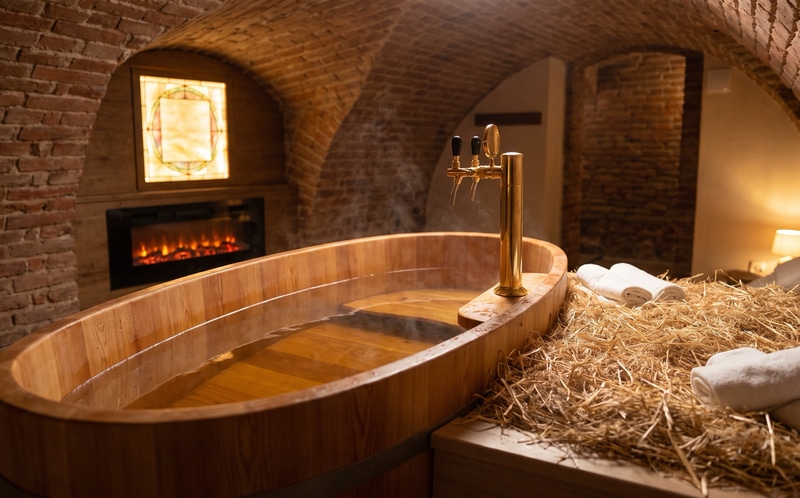
Then there is the skin. Aircraft cabin air is extremely dry, and transatlantic passengers often disembark with tight skin and cracked lips. We add a natural blend to the handmade oval tub in front of you. For the beer bath, that means Saaz hops, brewer's yeast and malt. Your room also has its own tap pouring Petrovické zlato craft beer, both pale and dark, straight from the keg, with a few snacks alongside. For the wine bath, the blend is red wine, grape seed extract, vine leaf, honey, herbs and French lavender flowers, and the bath comes with a bottle of wine and a plate of fruit and cheese.
Every room has a shower, but we recommend not rinsing the blend off for about two hours afterwards. If you can hold off, your skin stays softer and more supple for another day or two, which you will appreciate after a dehydrating flight or a day in an air-conditioned car. A small thing, admittedly. But small things like this are what separate an ordinary soak from a ritual that actually makes sense after travel.
Ninety minutes, step by step
A standard visit lasts 90 minutes in a private room that is yours alone. No strangers, no shared pools, no crowded changing rooms. After a day of airports, stations and transport, privacy is one of the things a tired traveller values most. Here is how the time unfolds:
- About 10 minutes of preparation. Your spa attendant talks you through the visit, fills the tub and adds the natural blend to the water while you watch.
- 20-30 minutes in the tub. Usually around twenty minutes, up to thirty if you like. The whirlpool runs automatically and the water stays between 35 and 38 °C.
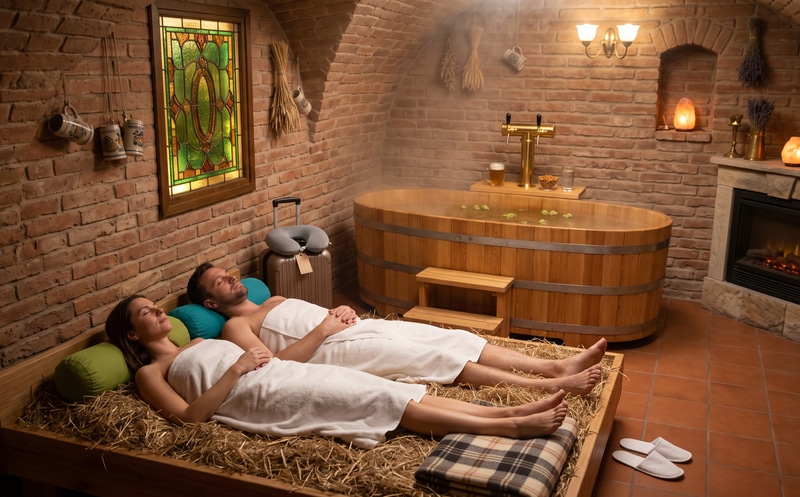
- About 50 minutes on a heated wheat-straw bed. You lie in complete quiet while the body gradually slows down.
- Finish. The shower in the room is there for you, but we recommend leaving the blend on your skin for about two hours.
For travellers, it is the third stage that matters most. Fifty minutes lying down, with no phone, no departure announcements and nowhere to rush to, sends the nervous system an unmistakable message: the journey is over. The straw radiates warmth from below, the electric fireplace gives off a soft glow with no real flame, and the low, warm lamplight rests eyes that have probably spent hours fixed on a screen.
Lying still after a long stretch of sitting is a different thing altogether. The spine can settle into a horizontal line, the legs rest at roughly heart height, and the body no longer has to hold a posture or pay attention to anything. If you doze off for a while, no harm done. Just make sure it stays a short evening rest rather than a two-hour mid-afternoon sleep, which would push bedtime even later.
So the full 90 minutes are more than "just a bath". They form a structured transition from travel mode to rest: first warmth and buoyancy, then calm and silence. After a long haul, that sequence is the most valuable thing the ritual can offer.
Evening slots, daylight and the body clock
When should you book? If you have arrived from another time zone, we recommend late afternoon or evening, local time. The reasoning is physiological. Sleep research has long shown that a drop in body temperature is part of falling asleep naturally. After a warm bath the body does not keep heating up; it slowly cools, and that gradual cooling is one of the recognised cues that sleep is on its way. If your bath ends a sensible interval before you want to go to bed on Prague time, you help the body catch that cue at the right hour.
The opposite approach, heading straight from the airport or the car to bed, often ends with you lying wide awake in the small hours. What helps is staying up until the local evening, spending as much of the day as possible in daylight, and only then letting the body wind down. In that plan, the spa is not a remedy. It is a pleasant, purposeful bridge between an active afternoon and the night.
It is only fair to mention alcohol. Beer and wine are part of our rituals: the beer bath comes with unlimited pale and dark beer and snacks, the wine bath with a bottle of wine. But alcohol is no friend to sleep. It may help you drop off, yet it worsens sleep quality and dehydrates you, which is the last thing the body needs after a dry flight. If you do have a beer or a glass of wine, match each one with a glass of water. Nobody will mind if you pour a single beer from the tap and drink water for the rest of the evening.
A few practical rules for that first evening:
- Book your bath for late afternoon or evening, local time.
- Stay awake through the day and get outside into daylight.
- Have a glass of water with every beer or glass of wine.
- Nothing demanding afterwards: a light supper, then bed on local time.
- Don't expect a miracle in one night; resetting the body clock takes days.
Which room and which ritual to choose after travel
Lázně Pramen in Dejvice has four private rooms, each suited to a slightly different situation. Prices are always per room, meaning per booking, not per person.
Ruby Spring (Rubínový pramen) is our most intimate room, for one or two guests, with a single larch tub with whirlpool, an electric fireplace and a heated wheat-straw bed. For a solo traveller or a couple who have just landed, it is the natural choice. The beer bath here starts from €148 per room and the wine bath from €201 per room. The price is the same for one guest as for two sharing the tub.
Golden Spring (Zlatý pramen) is our most spacious room, for 2-4 guests, and the only one with two tubs, both made of oak. It works well for a family or a group of friends back from a trip together. The beer and wine bath combination costs from €238 per room, two beer tubs from €190 and two wine tubs from €268.
Emerald Spring (Smaragdový pramen) is the V.I.P. room for one or two guests, with a single larch tub with whirlpool, a cedar phyto-sauna, an electric fireplace and a straw bed. A visit here lasts 2.5 hours, or 150 minutes. The phyto-sauna is a small upright barrel of Siberian cedar: your body sits in steam from herbal infusions while your head stays outside. Around 15 minutes in the cedar barrel are followed by 30 minutes of relaxing massage or a body scrub, then the bath and a rest by the fireplace. V.I.P. Beer SPA starts from €293 and V.I.P. Wine SPA from €326 per room. After a genuinely punishing long-haul flight, it is the most complete option we offer.
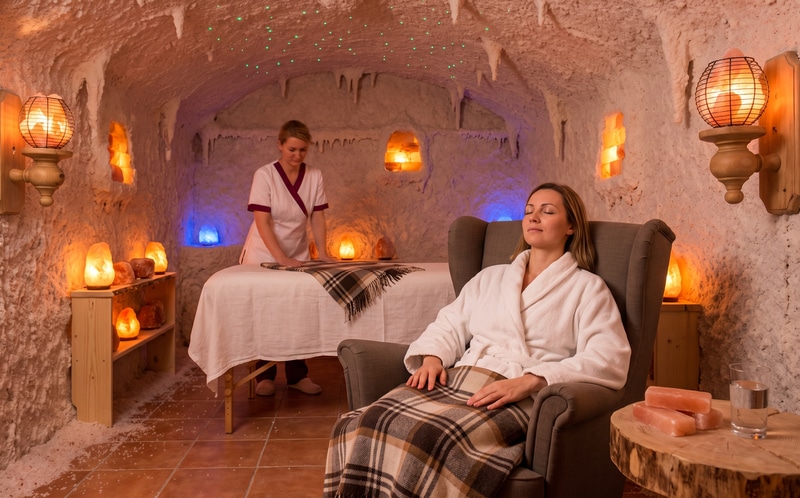
Sapphire Spring (Safírový pramen) is a salt cave lined with 10 tonnes of three kinds of salt: rock salt, Dead Sea salt and Himalayan salt. There is no tub; instead you will find a massage table and salt lamps. If your neck and shoulders took the worst of the journey, a 30-minute relaxing massage of the back, neck and shoulders from €33 is the obvious call.
In practice: the first evening after a flight or a night drive
A sample scenario shows what a well-planned first evening can look like. A couple land in Prague on a morning flight from Southeast Asia, with one connection. They have more than fifteen hours of travel behind them and body clocks running several hours ahead. It is around midday in Prague when they leave their luggage where they are staying in Prague 6. The temptation is to draw the curtains and sleep. Instead they go out for lunch, walk up to Prague Castle, a short hop from Dejvice, and spend as much time as they can outdoors in daylight.
For late afternoon they have booked a beer bath in Ruby Spring at €148 per room. Twenty minutes in water close to body temperature loosens backs and legs stiff from hours in a cramped seat. Each pours one beer from the tap and drinks water alongside. The fifty minutes on warm straw are the first real stillness since they set off for the airport. Afterwards they eat something light and are in bed by about ten, local time, as their bodies slowly cool.
That does not mean they wake up fully adjusted. Jet lag will make itself felt for several more days. But the first night falls at a reasonable hour, and that is a good start to the whole stay.
The closer-to-home version: a driver who has come back overnight from a seaside holiday sleeps until lunchtime, then books an hour-long massage in the salt cave of Sapphire Spring for the evening. A 60-minute full-body relaxing massage costs from €50, and a more intensive 60-minute sports massage from €75. We also offer 45 minutes of pressotherapy lymphatic drainage from €23. That one is a separate visit, though, and cannot be combined with a bath in the same slot. It cannot yet be booked online: you arrange it by phone via our contact page and pay on the spot.
Getting here with a suitcase and booking your first evening
You will find Lázně Pramen at Dejvická 255/18, Praha 6 - Dejvice, a two-minute walk from Hradčanská metro station. For new arrivals the location is a gift: if you are staying in Prague 6 or travelling on metro line A, you can reach us easily, suitcase and all, on your very first evening, with no hunting for the door and no taxi across the city. The Dejvice spa is part of the Lázně Pramen network, whose story goes back to 2008.
We are open from 10:00 to 22:00 on weekdays and from 10:00 to 23:00 at weekends. That matters for travellers: even if you land in the afternoon or roll in by car towards evening, an evening slot is still within reach. And as far as your body clock is concerned, the evening slot is the one that makes most sense.
Bookings are made online through our booking page, where you choose the room, the date and the type of bath. If you know your arrival date in advance, book early so the slot fits your plans exactly. You can browse every ritual on our treatments page.
Someone close to you coming home from a long trip? A gift voucher makes a thoughtful welcome-back present. They can choose a beer bath, a wine bath or a massage, and pick a date once they have recovered from the journey.
Our age policy, set out in Article 10 of our terms and conditions: entry is from 18; guests aged 15-17 are welcome only with a legal guardian; children under 15 have no access to the wellness area.
You can't undo a long journey, but you can give it a dignified ending: warm water, buoyancy, fifty quiet minutes on straw and an evening that eases the body gently onto local time. We look forward to welcoming you in Dejvice. The full list of contraindications is in Article 9 of our terms and conditions.
Sources
- Mayo Clinic: Jet lag disorder - symptoms and causes - www.mayoclinic.org
- PMC: Managing travel fatigue and jet lag in athletes (2021) - pmc.ncbi.nlm.nih.gov
- SLEEP: Insights about travel-related sleep disruption from 1.5 million nights of data (2025) - pmc.ncbi.nlm.nih.gov
- NHS: DVT (deep vein thrombosis) - www.nhs.uk