Pregnancy is a contraindication – the short, honest answer
The short, honest answer first: we do not recommend our beer baths, wine baths or massages at Lázně Pramen Dejvická during pregnancy. Pregnancy is listed in our Terms & Conditions (clause 9) as a contraindication, alongside cardiovascular disease, acute inflammation, open wounds, epilepsy and known allergies to bath ingredients.
That clause is not boilerplate. It sits on top of specific physiology and specific data on hot bathing in pregnancy. In this article we go through it piece by piece: what happens at 35–38 °C, why hops, yeast and wine in the water matter, what ACOG, Mayo Clinic and the NHS recommend, and what we actually offer instead. The aim is not to scare expectant mothers off spas as a category – only to explain why, at our spa specifically, we wait until after birth.
35–38 °C water and pregnancy: what the science says
Our water sits at 35–38 °C. For a healthy adult that is a safe, pleasantly relaxing range. In pregnancy two things change at once:
- Foetal thermoregulation. A foetus cannot sweat or cool itself – it sheds heat through the mother's blood. If maternal core temperature rises above 38–39 °C, the foetus has nowhere to dump that heat. A meta-analysis in Epidemiology (Moretti, 2005) of nine studies showed first-trimester heat exposure (hot tubs, saunas, fevers > 38.9 °C) roughly doubles the risk of neural-tube defects.
- Core temperature vs. water temperature. In 38 °C water the body cannot dump heat through sweat – sweat won't cool you against water of equal temperature. After 20 minutes in a whirlpool, your core temperature drifts towards the water's temperature. For a non-pregnant adult that is 38 °C of core, basically a "mild fever". For a pregnant woman that is the risk zone ACOG and the NHS specifically tell you to stay out of.
Our 35–38 °C is at the bottom edge of that risk zone – but still inside it. That is why, even at a temperature that looks "mild" to ordinary guests, we keep pregnant guests out of the bath.
Active compounds in the bath: hops, yeast, polyphenols
Heat is one layer; the other is what we actively add to the water:
- Žatec hops in the beer bath contain 8-prenylnaringenin, one of the most potent plant oestrogens (phytoestrogens) known. For non-pregnant adults that's neutral or mildly favourable. In pregnancy, exposure to potent phytoestrogens during foetal development is best avoided – data is thin, conservative is standard.
- Brewer's yeast is rich in B vitamins – not problematic in pregnancy by itself, but it arrives bundled with the rest.
- Red wine and grape extract in the wine bath carry trace ethanol. Concentration in the bath water is low and transdermal absorption is minimal, but "minimal" in pregnancy is not the same as "none" – and the recommendation from obstetric bodies on any ethanol exposure during pregnancy is precautionary.
- Herbal extracts and French lavender in normal cosmetic doses are not high-risk, but combined with heat and hop phytoestrogens, the package as a whole sits in the "better not" category.
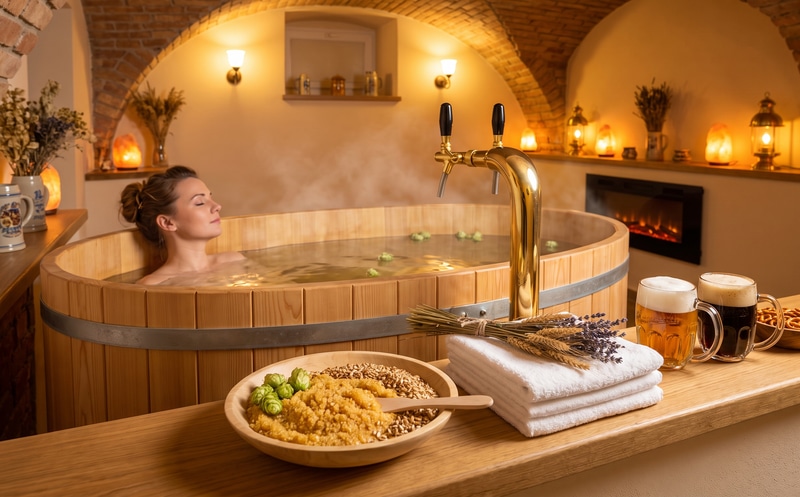
Bernard beer from the tap by the tub is obviously off the menu for the mother-to-be – but the active compounds in the water itself are above what prenatal guidance would recommend.
Whirlpool and hydrostatic pressure in pregnancy
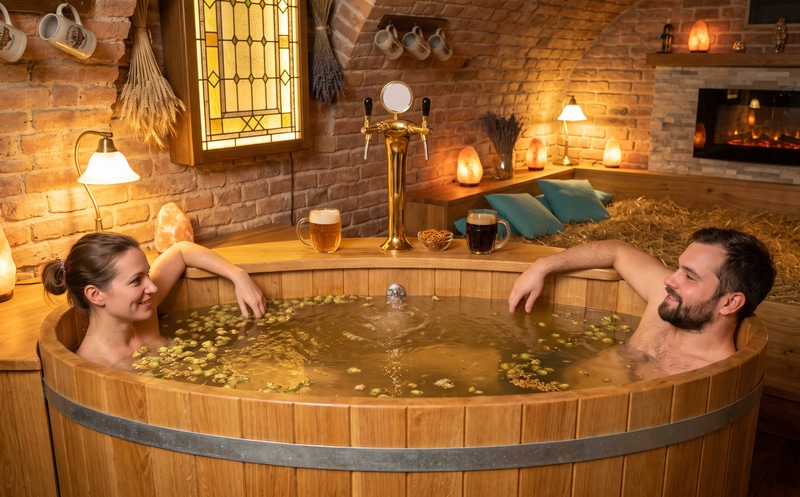
The whirlpool in our tub runs for 20 minutes. For a non-pregnant guest that's the core element of the session – an active hydromassage from air bubbles that loosens the back and peripheral circulation. In pregnancy two more issues add to the heat:
- Hydrostatic pressure. The water in the tub pushes on the abdominal wall and peripheral veins. By itself, in later pregnancy this increases the volume of blood returning from the legs to the heart. Combined with heat it can trigger hypotension (low blood pressure) and dizziness. The risk of fainting in a wet environment is not trivial.
- Vibration from the air jets has not been studied in pregnancy. Rather than chase proof of "harmlessness", the clean choice is to leave that exposure out of the prenatal period.
Massages (relax and sport) in Safírový pramen are also off the list – we are not a prenatal studio, our therapists are not trained in pregnancy-specific positioning, and we do not stock prenatally tested oils. The conservative call is to wait.
What ACOG, Mayo Clinic and the NHS say
Consistent recommendations from four mainstream medical authorities:
- American College of Obstetricians and Gynecologists (ACOG): avoid environments where core body temperature can exceed 39 °C – that is saunas, hot tubs and whirlpools, especially in the first trimester.
- Mayo Clinic: hot tubs and whirlpools in pregnancy raise the risk of hyperthermia. Short dips in pool water below 35 °C are usually fine; sustained immersion above 38 °C is not.
- British NHS: advises avoiding saunas, steam rooms and hot tubs throughout pregnancy.
- Royal College of Obstetricians and Gynaecologists (RCOG): general prenatal precaution – minimise exposure to heat, alcohol and unverified herbal preparations.
Our procedure stacks all three risk factors in one session: heat, herbal preparations (hops), trace ethanol (wine bath). That stack is why combining our procedures with pregnancy is conservatively inappropriate – and why our T&Cs reflect it.
What we offer expectant mothers instead
The aim is not "do not enter". The aim is to offer something useful for this period – and the next:
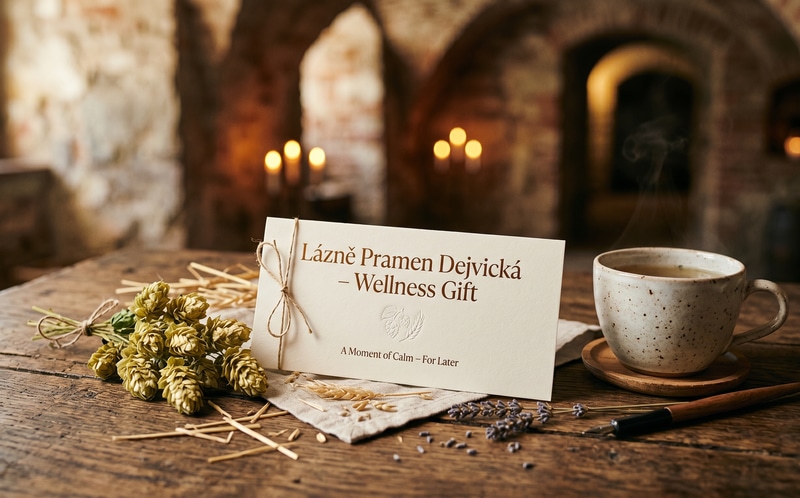
- An electronic gift voucher valid for 12 months. Wrap it into a birthday card or a "day-after-baby" card. When the mother returns (typically 6–8 weeks post-partum – see next section), she chooses her own date, no stress, no fixed slot.
- A partner visit. The father, or a close non-pregnant companion, can take the session himself, optionally with another non-pregnant friend. The expectant mother is welcome on premises as a guest in the fireplace lounge, with no hot or cold bath – just a chair, a herbal tea, a cake. Let us know in advance and we will set this up.
- Pre-conception planning. If you are not yet expecting but planning, we generally recommend avoiding hot baths and saunas from the moment you start trying – thermal exposure also affects sperm quality (Carlsen et al., Int J Androl).
When you can return to the spa after birth
General guidance (not a medical diagnosis – always confirm with your obstetrician):
- After uncomplicated vaginal birth: typically 6 weeks postpartum, once lochia has stopped and episiotomy scars have healed.
- After a caesarean: at least 8 weeks, after a wound check and your obstetrician's sign-off.
- While breastfeeding: beer or wine baths do not prohibit breastfeeding. The trace ethanol from a wine bath is absorbed through the skin only minimally and should not reach breast milk in meaningful amounts. Hops have a folk-medicine reputation as galactagogues (milk-promoting), but reliable data is limited. If you want belt and braces: feed before the procedure and time the next feed at least 2 hours after.
For a first return after birth we typically suggest the gentler version – a beer bath in Rubínový pramen (private, 1–2 guests, from €129) – with a shorter dip (15 minutes instead of 20). We will fine-tune on arrival.
I already have a booking – what now
If you already have a booking and have just realised you are pregnant, the fix is quick and free:
- Drop us a line via our contact page or by e-mail to info@dejvicka.laznepramen.cz. No documents to provide, no "proving" anything – just a note that you need to move the booking.
- The booking turns into a gift voucher valid for 12 months. Same money, same procedure, you pick the new date later.
- If 12 months is not enough (typically when you plan to return only after the post-partum window), write to us – we can extend voucher validity individually if you ask before it expires.
The spa is yours. Just not right now. We will be here after birth.
Sources
- Moretti M.E. et al. – Maternal hyperthermia and the risk for neural tube defects in offspring: systematic review and meta-analysis – Epidemiology, 2005 – pubmed.ncbi.nlm.nih.gov
- American College of Obstetricians and Gynecologists (ACOG) – Exercise During Pregnancy and the Postpartum Period (Committee Opinion 804) – acog.org
- Mayo Clinic – Pregnancy and hot tubs: Is it safe? – mayoclinic.org
- NHS UK – Sauna, hot tub and steam room use in pregnancy – nhs.uk
- Royal College of Obstetricians and Gynaecologists (RCOG) – Healthy eating and vitamin supplements in pregnancy – rcog.org.uk
- Suzuki K. et al. – Maternal hot tub or sauna use during early pregnancy and risk of spontaneous abortion – cohort study, 2018 – pubmed.ncbi.nlm.nih.gov