Why beer is finding its way back into skincare
We tend to picture beer in a glass, not in a face mask. Yet in the Czech lands the use of beer and its raw ingredients in bodycare runs surprisingly deep. Maltings, breweries and home recipes were working with yeast, hops and wort long before the first cream came in a tube. That tradition is returning now, this time backed by a clearer understanding of what each component actually does when you put it on your skin or into your bath. It is not a marketing gimmick. Hops, malt and brewer's yeast all contain substances the skin can genuinely make use of.
At its core, beer is a mixture of water, grain malt, hops and yeast. Each ingredient contributes something different to the blend. Malt brings carbohydrates and trace elements, hops carry aromatic resins and plant polyphenols, and yeast is naturally rich in B vitamins and amino acids. What is striking is that these are precisely the groups of substances cosmetics routinely add to products meant to soothe, nourish and soften the skin - except here they arrive from a source people have used and consumed for centuries.
This article takes a level-headed look at what each beer ingredient contains and why it turns up in natural cosmetics, in hair care and in beer baths. We are not promising miracles or patented technology. The aim is a clear explanation of why someone reaches for a beer shampoo, and why bathing in beer feels good for the skin. And because we work with the same ingredients in our private rooms in Dejvice, we finish by showing how you can try the whole ritual for yourself. Beer beauty makes the most sense when you experience it rather than just read about it.
One thing before we start: we are not doctors, and this text is not medical advice. It is a guide to the ingredients and their traditional and modern uses in skincare. If you are dealing with a specific skin condition, ask a dermatologist.
Hops: a plant with polyphenols and a lovely scent
The common hop (Humulus lupulus) is without doubt beer's most distinctive ingredient. What gives beer its bitterness and aroma are the resins and essential oils tucked inside the yellow glands of the hop cones. Alongside these, hops also contain a group of plant polyphenols and flavonoids, the best known of which is xanthohumol. These are exactly the compounds that draw attention beyond the brewhouse, because they are plant antioxidants - and cosmetics take an interest in antioxidants for their ability to neutralise free radicals.
In skincare, antioxidants help counter the oxidative stress that, together with UV exposure and pollution, tires the skin and speeds up the signs of ageing. That is why hop polyphenols show up in creams and serums labelled as "hops cream", meaning a cream with hop extract aimed at calming the skin and supporting its defences. Hops also carry a long-standing reputation as a soothing plant. In herbalism they went into sleep pillows and baths to encourage relaxation, and while that is not a cosmetic effect in the strict sense, the sense of calm is part of why hop rituals do people good.
The scent of hops is another, often underrated part of the experience. The fresh, herbal-resinous note of fresh cones is unmistakable, and in a bath setting it creates an atmosphere that synthetic fragrances struggle to imitate. In our beer bath we use Žatec hops, added to the tub right in front of you, so what you smell is the real ingredient rather than aroma from a bottle.
It pays to stay with the facts. Hops are not a medicine, and their polyphenols are no miracle rejuvenating cure. This is a plant ingredient with antioxidant potential and a pleasant sensory profile, and it has a logical place in natural cosmetics and bathing care. If you have a diagnosed hop allergy, caution applies - you will find the full list of contraindications in our terms and conditions.
Brewer's yeast: B vitamins for skin and hair
If there is one beer ingredient cosmetics love most, it is brewer's yeast. The Saccharomyces yeasts that turn sugar into alcohol and carbon dioxide in the brewery are themselves tiny nutrient factories. Dried brewer's yeast is naturally rich in B vitamins, amino acids, trace elements and beta-glucans. It is precisely this profile that has made it a favourite ingredient in supplements sold "for skin, hair and nails" as well as in cosmetics applied to the skin.
B vitamins matter for the skin because they play a part in cell renewal and in maintaining the skin's barrier function. Niacinamide, a form of vitamin B3, is today one of the most researched cosmetic actives of all - it supports the skin barrier and helps even out skin tone. So yeast is not a random additive but a source of substances that modern dermo-cosmetics uses deliberately. Beta-glucans from yeast, meanwhile, feel soothing and hydrating, and appear in products as an ingredient that improves the comfort of irritated skin.
In hair care, yeast has a traditional reputation as a strengthening ingredient. Home recipes for beer hair treatments and commercial beer shampoos build on the combination of malt sugars and yeast compounds that lend hair volume and shine. This is where the much-discussed "beer shampoo benefits" come from. A beer shampoo works no wonders on hair density, but the malt proteins and sugars can coat the hair shaft and add the look of fullness and gloss, which shows when you style.
In a beer bath, yeast works together with malt and hops as a whole. There is no isolated extract stirred in here, but real beer enriched with hops, malt and yeast, so the skin receives a complex mix of substances all at once. That is the principle behind our beer bath - the skin bathes in the ingredients themselves, not in a substitute for them.
Malt, sugars and how beer softens the skin
Malt is sprouted, dried grain, most often barley, and it gives beer its colour, body and natural sweetness. During malting and mashing, the starch releases sugars - mainly maltose - and with them come minerals and trace elements from the grain. In the context of skincare it is exactly these carbohydrates that are interesting, because sugars are natural humectants, substances that can bind water.
Humectants are the backbone of moisturising cosmetics. Glycerine, hyaluronic acid and natural sugars all attract moisture and help hold it in the upper layers of the skin, so it looks supple and smooth. Malt sugars in a beer bath work on the same principle - they coat the skin in a thin film that traps moisture. This is also why, after a beer bath, the skin often stays pleasantly soft to the touch into the next day.
Malt is behind one of our most important pieces of after-treatment advice, too. We recommend waiting roughly two hours after a beer bath before you shower with soap, letting the beer extract carry on working on your skin. The malt sugars, yeast compounds and hop polyphenols all need time to be absorbed and to stay put. Wash them off straight away with a harsh soap and you rob yourself of most of the effect. Leave them, and the skin stays smoother and more saturated for a day or even two.
Malt also shapes the colour and scent of the bath. Dark malt gives beer its caramel notes, which you catch even in the steam above the tub. Combined with the aroma of hops and the warmth of the water, it becomes a sensory experience as close to skincare as it is to gastronomy. In our wine bath, grape sugar and honey play a similar role, but that is another chapter of natural bathing cosmetics.
Beer shampoo and hair care: fact and folklore
Beer on the hair is one of the oldest grandmother's recipes going, and it still has its devoted fans. The question is how much of it is a real effect and how much is simply tradition. Let us be sober about it. The hair shaft is largely keratin, and its appearance is governed above all by how smooth the outer cuticle is and how well hydrated the hair is. Beer enters this equation through malt sugars and yeast proteins, which can coat the hair and give it the look of volume and shine.
That explains the often-cited "beer shampoo benefits". After rinsing hair with beer or using a beer shampoo, the hair looks fuller and glossier. Not because beer changes the structure of the hair from within, but because the sugars and proteins on the surface reflect light and add body. The effect is temporary and washes out at the next wash, which for a cosmetic with no permanent chemical action is entirely normal and perfectly fine.
- Malt sugars coat the hair and add the look of volume and shine
- Yeast proteins and B vitamins have a traditional reputation as a strengthening component
- Hop polyphenols bring an antioxidant profile and a fresh scent
- The effect is superficial and temporary, lasting until the next wash
- Commercial beer shampoos usually combine beer extract with ordinary cleansing and conditioning ingredients
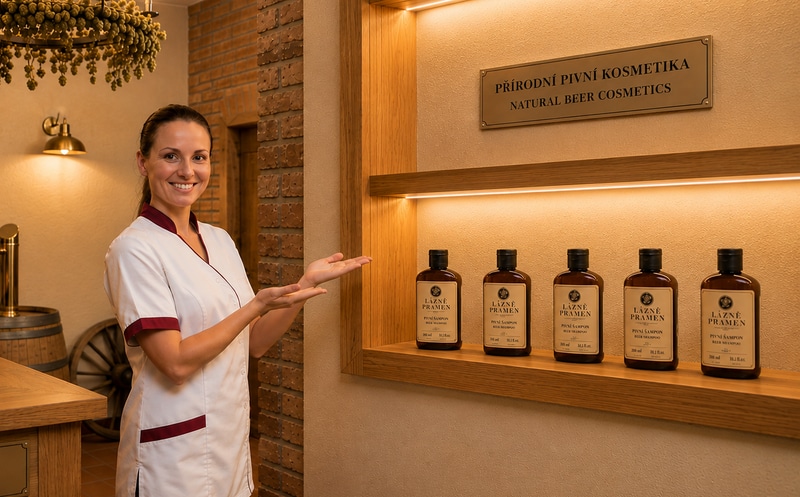
Home recipes generally involve rinsing the hair with flat beer after washing. If you try it, let the beer stand for a while so the carbon dioxide escapes, and reach for a lighter, less hoppy beer to avoid an intense scent. And let us be honest, this is home-cosmetics territory. And in Dejvice we make it ourselves: beer shampoo, hair balm, body peeling and scrub, and bath salt. You can buy them at our reception. But if the ingredient logic of beer has caught your interest, it makes sense to start with the beer bath, where the same substances work across the whole skin at once.
Natural beer cosmetics versus a real bath in beer
The market today offers a wide range of products that lay claim to beer: hop creams, yeast serums, malt body lotions, beer shampoos and soaps. These "natural beer beauty products" have their logic. They take a specific active component from beer, isolate or concentrate it, and work it into a formulation you use at home every day. The advantage is obvious: consistency. A cream with hop extract used daily delivers antioxidants steadily, which makes sense for long-term care.
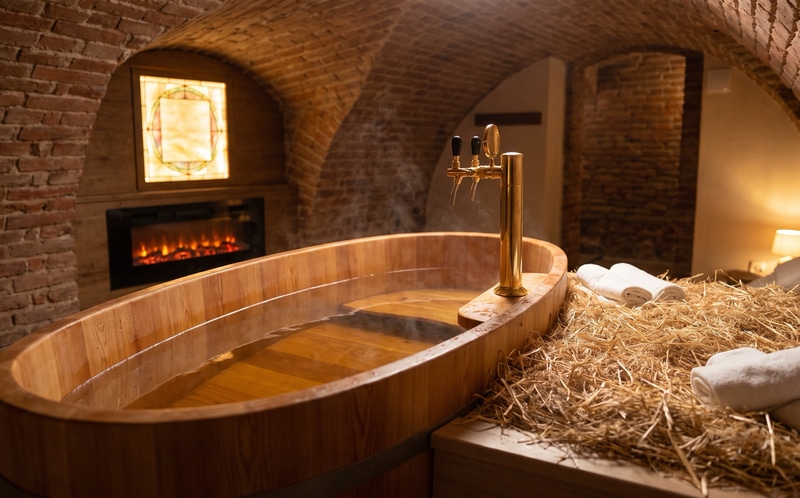
A real bath in beer works differently. It is not a daily routine but a concentrated, immersive experience, where the skin bathes in the ingredients all at once and at a strength you will never reach in a home cream. In our beer bath the tub is filled with real Petrovické zlato beer, Žatec hops, a malt component and yeast - not aroma or an extract from a bottle. The water sits at 35-38 °C, which helps open the pores and encourages circulation in the skin, and an automatic whirlpool keeps a gentle flow going. It is the combination of heat, active substances and time that makes the bath a different experience from a morning cream.
The ideal is to combine the two. A beer bath now and then as a ritual and a deeper saturation of the skin, and at home natural cosmetics with beer components for everyday upkeep. One does not replace the other, they complement each other. And unlike an isolated product, the bath gives you what no tube can hold: warmth, scent, calm and an hour and a half without your phone.
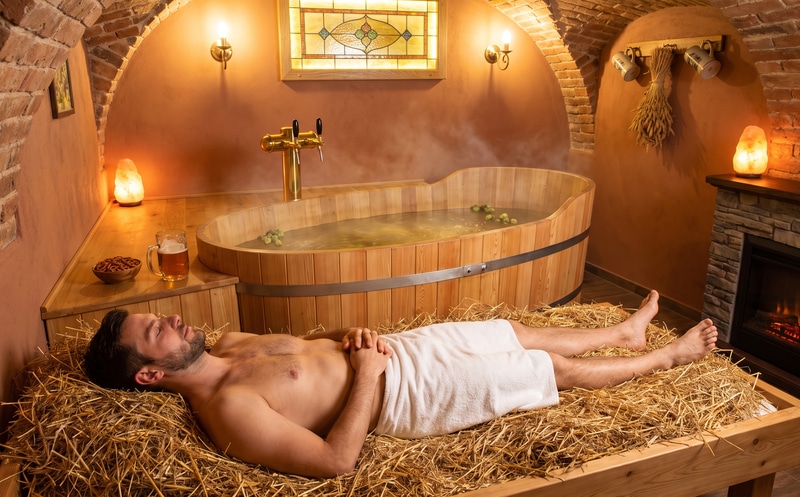
The structure of our treatment reflects this. You spend the first twenty minutes or so in the tub, where the beer extract and warm water work on the skin, and the following fifty minutes or so resting on a heated wheat-straw bed while the substances absorb. Ninety minutes in all, during which the beer does the work for you. Anyone wanting to raise the experience can opt for the V.I.P. treatment in Smaragdový pramen with a cedar phytobarrel and a massage.
What a beer ritual for the skin looks like in Dejvice
Coming in for a beer bath is not about drinking, it is about care. You book through the reservation form on the website, choosing your date, the number of guests and the type of bath. The price is always for the whole reservation, that is for the room rather than per person - a detail that pleasantly surprises many people. A beer bath in a single tub for one or two guests starts from 148 EUR per reservation, and the price is the same whether you come alone or share one tub as a pair.
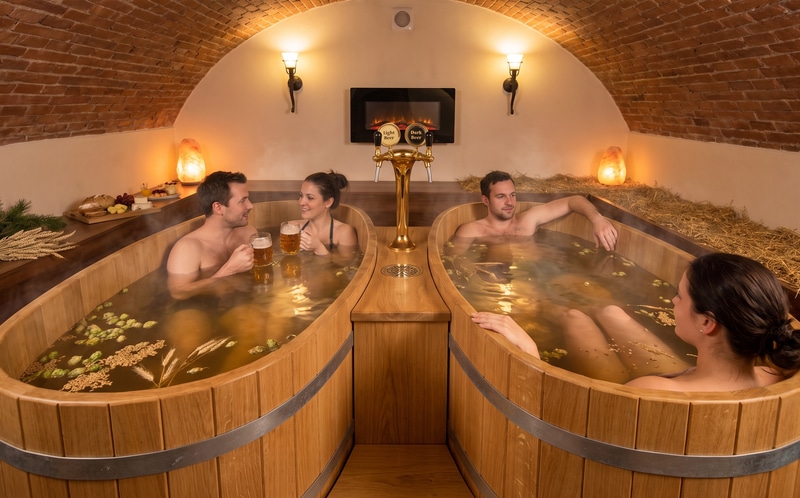
For a couple wanting privacy and an intimate mood, Rubínový pramen is ideal - our most intimate room, with a single larch tub and whirlpool, an electric fireplace with a flame effect and a heated straw bed. If you arrive in a larger group of up to four, the doors of Zlatý pramen open, the only room with two tubs side by side. There you can even enjoy a combination of beer and wine in two tubs at once, with each guest in their own bath to taste.
Anyone who wants to get the most out of beer cosmetics for the skin will appreciate Smaragdový pramen, our V.I.P. room for one or two guests. The V.I.P. Beer SPA from 293 EUR per reservation opens with a fifteen-minute cedar phytobarrel, continues with a relaxing massage or a body scrub, and ends with a beer bath and rest. The phytobarrel is a small cabin of Siberian cedar you sit inside up to the neck, with your head staying outside, and the herbal steam prepares the skin for the bath and opens the pores. For wine lovers we offer a wine bath from 201 EUR per reservation with a bottle of wine right there in the room.
Whatever you choose, the same principle holds: reward your skin's softness after the treatment by not showering with soap for two hours. That gives the hops, malt and yeast time to finish their work. And if you want to give the experience as a gift, we have gift vouchers valid for a year, letting the recipient choose their own treatment.
In short: beer as skincare that makes sense
Beer beauty is not a hollow fad. Behind the popularity of hops, malt and yeast in skin and hair care lie specific substances that cosmetics use well beyond the beer context. Hops bring plant polyphenols and antioxidants along with a pleasant, fresh scent. Brewer's yeast is a source of B vitamins, amino acids and beta-glucans that support the comfort and nourishment of the skin. Malt supplies natural sugars that act as humectants and help keep the skin hydrated and soft. Together they form an ingredient base with a logical place in natural cosmetics.
Let us keep our expectations realistic. A beer cream, shampoo or bath is no miracle cure, and none of them replaces dermatological care for genuine skin problems. They are means for everyday and occasional care that build on proven natural ingredients. The effect of a beer hair rinse is superficial and temporary, the antioxidant profile of hops is support rather than a treatment, and the hydration from malt sugars is pleasant but not permanent. That honesty is, to our mind, what is so likeable about beer cosmetics - you are not kidding yourself.
Where beer really shines, though, is the experience. The difference between applying a cream in the morning and a ninety-minute soak in a warm bath steeped in hops, malt and yeast is enormous. In the bath all the components work at once, the heat opens the pores, the scent calms you and time passes differently. That is why we recommend combining both: our own beer cosmetics from the reception at home for regularity, and the beer ritual in our private rooms for depth and rest.
If the beer ingredients and their effect on the skin have caught your interest, the best way to understand them is to try it on your own skin. Take a look at the full range of treatments, or get in touch through our contact page and we will happily help you choose. Beer beauty makes the most sense the moment you sink into the tub and feel the beer working for your skin.
Sources
- Xanthohumol from hops and its antioxidant and biological effects (PubMed) - pubmed.ncbi.nlm.nih.gov
- Niacinamide (vitamin B3) in skincare and the skin barrier (PMC) - www.ncbi.nlm.nih.gov
- Beta-glucans and their effect on the skin (PMC) - www.ncbi.nlm.nih.gov
- Humectants and skin hydration - a review (PMC) - www.ncbi.nlm.nih.gov
- Humulus lupulus (hops) - phytochemistry and uses (PMC) - www.ncbi.nlm.nih.gov
- Antioxidants in cosmetics and protection against oxidative stress (PMC) - www.ncbi.nlm.nih.gov