What resveratrol is and why it belongs in a bath
Resveratrol is a natural stilbene from the polyphenol group. In the plant world it works as a stress response: the grapevine synthesises resveratrol in the berry skin in response to UV exposure, mechanical damage and fungal attack. The main dietary sources are grape skins and seeds, red wine, peanuts and some berries.
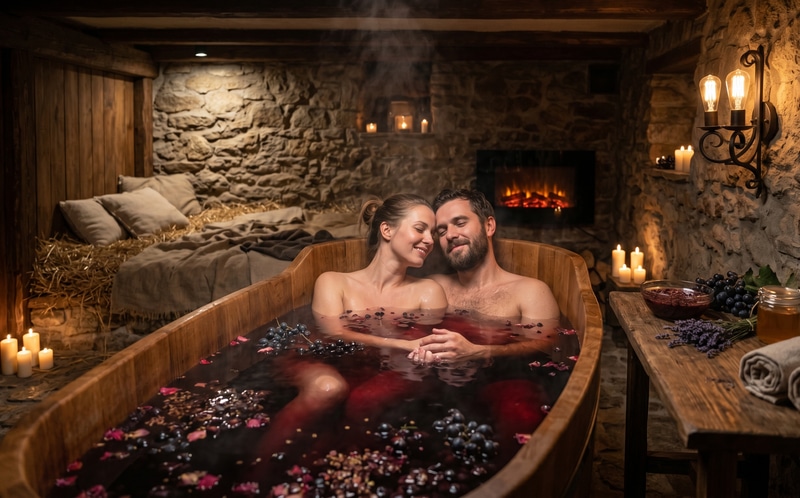
The wine bath at Lázně Pramen (€183, 1–8 guests) does not use wine itself, but a concentrated extract from grape seeds and skins with added honey, lavender and an herbal blend. Seeds and skins are the main reservoir of resveratrol and OPC (oligomeric proanthocyanidins). A glass of wine contains 0.3–1.5 mg of resveratrol; the extract in the bath contains tens of times more, and delivery happens through the skin, bypassing the liver and alcohol metabolism.
Mechanisms: antioxidant and SIRT1 activator
The scientific literature describes three key mechanisms of resveratrol that are relevant for the skin:
- Antioxidant action. Resveratrol neutralises reactive oxygen species (ROS) and reduces oxidative stress in keratinocytes – confirmed in the review by Ndiaye et al. (2011, Archives of Biochemistry and Biophysics).
- SIRT1 activation. The work of Howitz et al. (2003, Nature) showed that resveratrol stimulates sirtuin-1 – a cellular "repair" enzyme that participates in DNA repair and slows replicative cell ageing. The review by Baur & Sinclair (2006, Nature Reviews Drug Discovery) describes this activity as one of the most promising routes to extending cellular health.
- Anti-inflammatory effect. Resveratrol inhibits NF-κB and reduces pro-inflammatory cytokine production in the skin – the clinical application is discussed in the review by Farris et al. (2013, Journal of Drugs in Dermatology).
Transdermal absorption: why a warm bath works
The key question: does resveratrol from the bath reach the skin? The answer is confirmed by laboratory models. Warm water at 35–38 °C dilates capillaries, increases stratum corneum hydration and facilitates the passage of lipophilic molecules. Resveratrol's lipophilicity (logP ≈ 3.1) and its small molecular mass (228 Da) are ideal parameters for passage through the stratum corneum.
The study by Gokce et al. (2012, International Journal of Nanomedicine) confirmed that under topical application resveratrol retains its antioxidant activity and accumulates in the epidermis. 20 minutes in a 35–38 °C bath is the window during which the active components have time to act at the keratinocyte level.
OPC from grape seeds: synergy with resveratrol
Resveratrol is not alone in the extract. Grape seeds contain oligomeric proanthocyanidins (OPC) – another family of polyphenols. According to data from Bagchi et al. (2003, Toxicology), OPC are 20 times more active than vitamin C and 50 times more active than vitamin E as free-radical scavengers.
In practice this means the extract from seeds and skins in the wine bath works as a multi-level antioxidant system. Resveratrol and OPC act synergistically – different radicals, different targets in the cell, different stages of the oxidative cascade. For ageing or dehydrated skin (after summer, or in winter during the heating season) this is especially important.
Wine bath at Lázně Pramen: composition and protocol
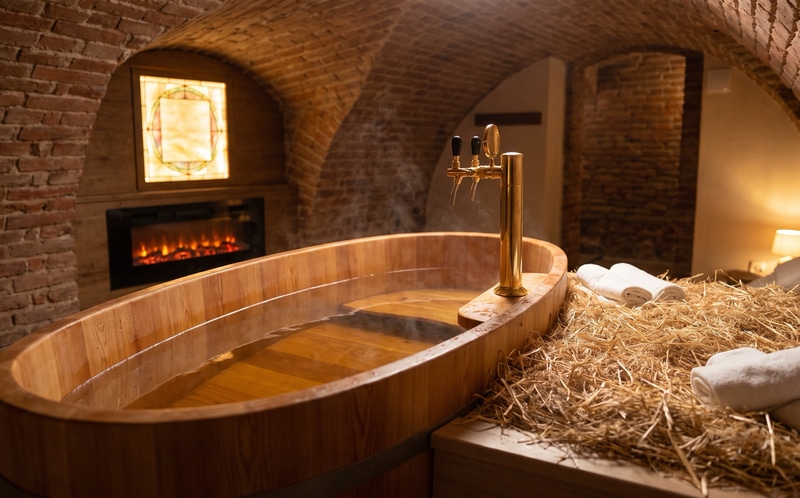
The wine bath (€183 per treatment, 1–8 guests) takes place in the Emerald Spring or the Golden Spring. An oak or larch tub is filled with water at 35–38 °C and the concentrate:
- Extract from grape seeds and skins – reservoir of resveratrol, OPC and catechins
- Honey – natural sugars and mild antimicrobial action
- Lavender – essential oils, calming effect on the CNS
- Herbal blend – additional phytocomponents
Protocol: 20 minutes in the bath. Stable temperature, no fluctuations. Afterwards – rest on a straw bed beside the electric fireplace.
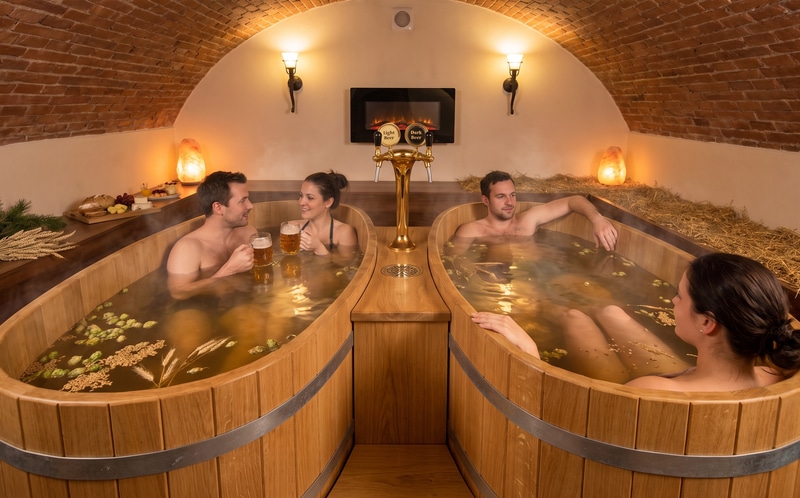
For those who want to try both a beer and a wine bath in a single visit – the Two-in-One combo (€238). It is a price compromise: separately a beer bath €129 + wine bath €183 = €312, in the combo €238.
Delux Wine SPA: resveratrol on every level
If the goal is maximum polyphenol exposure in a single session, Delux Wine SPA (from €326) in the Emerald Spring is built exactly around that. The 2.5-hour programme:
- Wine peeling – mechanical removal of the keratinised layer, preparing the skin for absorption
- Wine wrap – direct contact of active substances with the skin for 20–30 minutes, occlusive effect
- Wine bath – deep penetration in warm water
- Massage – enhanced blood flow, distribution of active substances
- Bathrobe included (other Lázně Pramen treatments do not include a robe)
This is the only product in which resveratrol and OPC act simultaneously through three different absorption modes: mechanical peeling, wrap occlusion and the convective heat of the bath.
Treatment course and gift vouchers
A one-off wine bath works well as an introduction or a single recovery session. For a cumulative antioxidant effect on the skin – a course of 4–6 treatments with an interval of 1–2 weeks. This sustains the antioxidant status of keratinocytes over a 4–8 week window without decline.
The wine theme works well as a gift voucher:
- For a couple: Two-in-One combo (€238) – 2 baths in a single visit
- For a wife, mother, friend: Delux Wine SPA (from €326)
- Universal: a voucher for an amount, the recipient chooses
Vouchers are issued online, valid for 12 months and delivered by e-mail. See all options and prices here. If you need a consultation – get in touch. Further materials on wine and beer therapy are on the blog.
Sources
- Ndiaye M. et al. (2011). The grape antioxidant resveratrol for skin disorders: promise, prospects, and challenges. Archives of Biochemistry and Biophysics, 508(2), 164–170. pubmed.ncbi.nlm.nih.gov/21557218
- Howitz K.T. et al. (2003). Small molecule activators of sirtuins extend Saccharomyces cerevisiae lifespan. Nature, 425(6954), 191–196. pubmed.ncbi.nlm.nih.gov/12939617
- Baur J.A., Sinclair D.A. (2006). Therapeutic potential of resveratrol: the in vivo evidence. Nature Reviews Drug Discovery, 5(6), 493–506. pubmed.ncbi.nlm.nih.gov/16732220
- Farris P. et al. (2013). Resveratrol: a unique antioxidant offering a multi-mechanistic approach for treating aging skin. Journal of Drugs in Dermatology, 12(12), 1389–1394. pubmed.ncbi.nlm.nih.gov/24301240
- Bagchi D. et al. (2003). Molecular mechanisms of cardioprotection by a novel grape seed proanthocyanidin extract. Toxicology, 148(2–3), 187–197. pubmed.ncbi.nlm.nih.gov/12974060
- Gokce E.H. et al. (2012). Resveratrol-loaded solid lipid nanoparticles versus nanostructured lipid carriers: evaluation of antioxidant potential for dermal applications. International Journal of Nanomedicine, 7, 1841–1850. pubmed.ncbi.nlm.nih.gov/23285081