Introduction: Beer spas as an extension of brewing
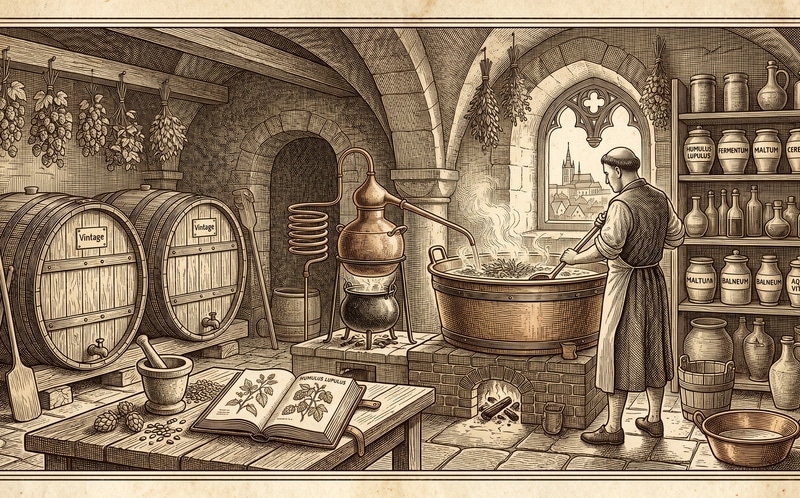
Beer spas in Czechia are not a marketing invention or a recent trend. They continue a brewing tradition that goes back to the 12th century, and they use ingredients that have stayed in the Czech beer recipe ever since – hops, malt, yeast and water. Lázně Pramen Dejvická is one of the Prague addresses where that tradition has been turned into a modern wellness ritual for couples, individual guests and small groups.
This article walks through the history: how brewing craft and bathing culture intersect, how the first modern Czech beer spa opened in Chodová Planá in 2006, and how the wave reached Prague. We also look at the active compounds that make beer and wine baths a meaningful wellness intervention – and at the treatments we run today.
Czech beer culture: roots from the Middle Ages
Czechia consistently ranks at the top of global per-capita beer consumption. Pilsner Urquell was first brewed in Pilsen in 1842 and defined the pale lager style that the rest of the world later copied. Alongside it, Bernard from Humpolec – an unpasteurised, yeast-rich beer, the same one we use in our beer bath – and Budvar from České Budějovice anchor Czech brewing identity.
Brewing is woven into Czech everyday culture: pubs, taverns, cellars, festivals. Pilsner Fest in Pilsen, regional Slavnosti piva and the Czech Beer Festival in Prague pull in locals and visitors alike. High beer consumption, the quality of small breweries and respect for raw materials make beer spas a natural extension of the craft, not an exotic tourist gimmick.
Modern beer spas begin: Chodovar 2006
The modern Czech beer spa has a precise starting point. In 2006 the Chodovar family brewery in Chodová Planá (Plzeň region) opened a beer spa under the registered trademark Pravá pivní lázeň®. They built it inside 800-year-old granite cellars directly under the brewery – the same cellars where beer had always been stored, because the granite holds a constant temperature. The recipe combines the on-site Il-Sano® mineral water, a dark unpasteurised lager, live brewer's yeast and spent hops.
From that pioneering location, beer wellness gradually spread to other regions – Karlovy Vary, Prague, Brno, smaller spa towns. There are now several dozen operations in Czechia, ranging from tourist attractions to urban private spas focused on quietness, vat care and a proprietary blend. Lázně Pramen Dejvická belongs to the second category.
Why a beer bath is more than water with beer
A beer bath is not diluted beer, and it is not marketing. The scientific literature – for example the review Beer and beer compounds: Physiological effects on skin health from Technical University of Munich – describes hops (Humulus lupulus) as a source of polyphenols (humulone, lupulone, xanthohumol) with antibacterial, anti-inflammatory and antioxidant properties. A 2025 study in Cosmetics (MDPI) measured a clear antimicrobial effect of hop extracts against Staphylococcus aureus, the bacterium tied to atopic dermatitis.
Brewer's yeast (Saccharomyces cerevisiae) is a source of B-group vitamins (B1, B2, B3, B6, B9 folate, B12) that support skin regeneration. A 2026 clinical study published in Cosmetics (MDPI) found that 30 days of topical application of formulations based on beer, yeast and spent grain improved skin hydration and elasticity and reduced trans-epidermal water loss (TEWL). Warm water at 35–38 °C in the bath dilates capillaries and increases stratum corneum hydration, helping active molecules cross into the upper layers of the skin.
In our beer bath we use unpasteurised Bernard beer. The composition in the tub – beer, malt, hops, yeast, warm water at 35–38 °C, whirlpool – is the classical Czech beer-spa recipe, not a patented technology.
Vinotherapy: Czech roots in Moravia
Vinotherapy as a concept came from Bordeaux (Caudalie, 1993), but in Czechia it has a natural base in the wine regions of South Moravia – Mikulovsko, Slovácko, Velkopavlovicko and Znojemsko are the four main wine sub-regions. A wine bath uses extract from grape seeds and skins, where two key polyphenol families sit: resveratrol (a stilbene, the vine's stress response to UV) and OPCs – oligomeric proanthocyanidins.
In our wine bath the tub holds extract from grape seeds and skins, honey, lavender and a herbal blend. Water at 35–38 °C, whirlpool, 20–30 minutes in the bath. For a deeper read on resveratrol, see our separate piece Resveratrol in our wine bath.
Rooms at Lázně Pramen Dejvická
Our Prague branch at Dejvická 255/18 (Prague 6) has 3 private rooms with tubs and 1 room with a salt cave:
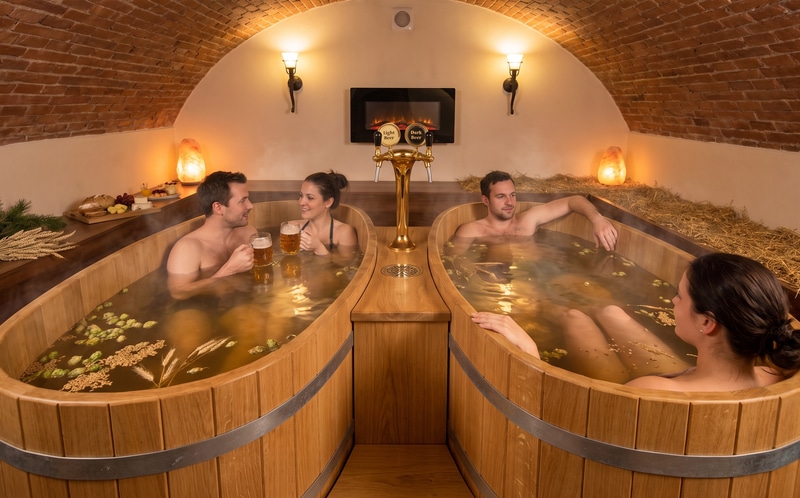
- Zlatý pramen (Golden Spring) – 2 royal-oak tubs with whirlpool, 2–4 guests. The largest room.
- Rubínový pramen (Ruby Spring) – 1 Siberian-larch tub with whirlpool, 1–2 guests. Intimate, ideal for couples.
- Smaragdový pramen (Emerald Spring) – 1 larch tub with whirlpool + cedar phyto-sauna barrel and electric fireplace. V.I.P., 1–2 guests.
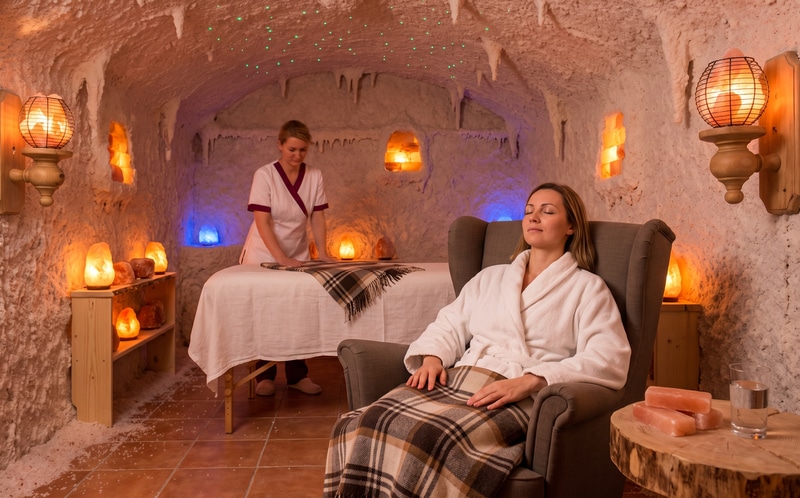
- Safírový pramen (Sapphire Spring) – salt cave + massage table, no tub. For 1 guest.
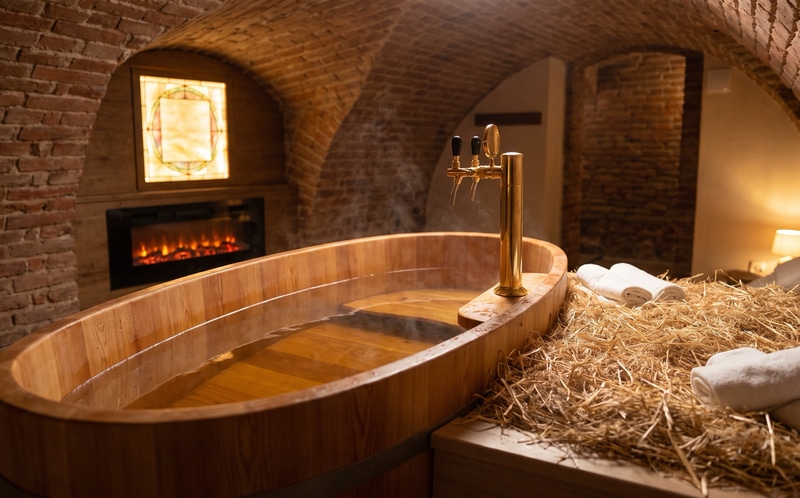
Tubs are hand-built from oak or larch (larch is naturally antiseptic) and all have whirlpools. After the bath, guests rest on a bed of fresh wheat straw next to the fireplace – the polyphenols from beer or wine keep working for another 30–60 minutes after you leave the tub. The full list is on the Rooms page.
Treatments and packages
What Lázně Pramen Dejvická offers right now:
- Beer bath – from €129 (1–2 guests, 90 minutes)
- Wine bath – from €183 (1–2 guests, 90 minutes)
- Two in one – beer + wine baths in the Zlatý pramen room
- Massages – Relax 30 min (from €33), Relax 60 min (from €50), Sport 60 min (€75)
- V.I.P. packages – Beer SPA, Wine SPA, Delux Wine SPA with massage and a wine pairing
The full catalogue with durations and prices lives on the Treatments page.
Gift vouchers
For birthdays, anniversaries or Christmas we offer gift vouchers in any amount. The voucher is valid for 12 months and the recipient picks the treatment and the date. For questions, see the Contact page.
Sources
- Family brewery Chodovar – Chodová Planá (GreatSpas.eu) – www.greatspas.eu
- Chodová Planá – Wikipedia – en.wikipedia.org
- Beer and beer compounds: Physiological effects on skin health – TU München – portal.fis.tum.de
- From Brewing Waste to Skin Health: Humulus lupulus – Cosmetics (MDPI, 2025) – www.mdpi.com
- Effect of fermentation conditions of brewing yeasts on folate production – ScienceDirect – www.sciencedirect.com
- Beer as Medicine: Through the Ages, Health Benefits – Healthline – www.healthline.com