Grapevine as an inspiration for Czech skincare
In the Czech imagination, grapevine carries more weight than a simple crop. It belongs to the landscape, to the culture of southern Moravia, and increasingly to the language of modern skin care. When Czech beauty brands draw on wine, the point is not merely a postcard image of vineyards or the easy romance of a glass of red at the end of the day. What gives the theme staying power is the material itself - the compounds found in grapes, vine leaves and seeds that make genuine sense in cosmetic and dermatological contexts. Polyphenols sit at the centre of that conversation, alongside grape seed oil, prized for its light feel and its fatty acid profile.
That is why grape-led skin care has proved more resilient than a passing seasonal motif. People are looking for products and rituals that offer both provenance and purpose. Grapevine does both unusually well. It comes with a strong regional identity and an instantly legible symbolism, yet it is also tied to ingredients that have been examined in specialist literature. Research into polyphenols and other plant antioxidants suggests they may play a role in helping protect the skin against oxidative stress, one of the pressures associated with both environmental exposure and visible ageing.
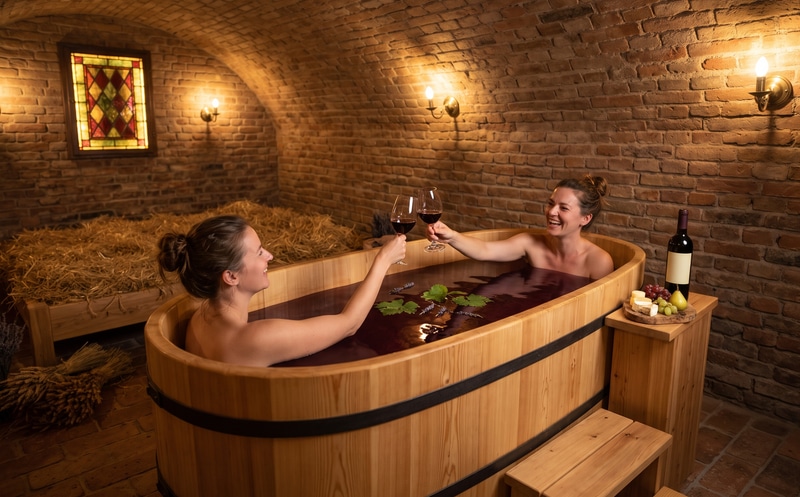
In the Czech setting, this story also slips easily into spa culture. The idea does not stop at creams, oils or serums. It extends to rituals built around warmth, stillness and sustained contact with active ingredients. That is where the wine bath at Lázně Pramen comes into focus, combining red wine, grape seed extract, vine leaves, honey, herbs and French lavender flowers. It is not cosmetic care in a bottle, but it follows the same logic - using the potential of grapevine within a treatment designed for regeneration and deep rest.
So Czech wine-inspired beauty sits in an appealing middle ground between tradition and a modern reading of efficacy. That balance is precisely why grapevine feels established rather than fashionable - a stable part of a broader shift toward regional ingredients with a credible place in contemporary body and skin care.
What makes grape extracts interesting for the skin
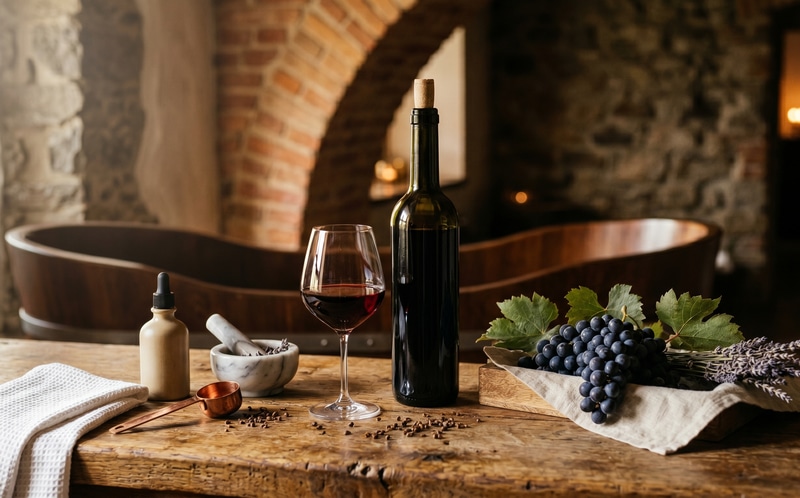
Say grapevine cosmetics and many people still picture fragrance first - perhaps the scent of wine, perhaps the styling. In reality, the interest is far more practical. Grapes, skins, seeds and leaves all contain compounds that are valued for their protective and supportive potential in skin care. Scientific papers frequently point to polyphenols, including resveratrol and other flavonoids, which are studied for their antioxidant activity. In skin care terms, that matters because oxidative stress is one of the mechanisms linked to premature ageing, and ingredients with antioxidant potential are often explored for the way they may help support the skin barrier and overall skin resilience.
Grape seed oil is another key part of the picture. It is appreciated for its high proportion of unsaturated fatty acids and for a texture that feels notably lighter than many richer oils. It absorbs well, sits comfortably on the skin and often appeals to those who want nourishment without heaviness. That is why it appears so often in emulsions, body oils and massage products. Grapevine, then, is not simply a decorative concept in cosmetics. It is a source of several different ingredient families, from antioxidant extracts to lipid-rich components that can improve comfort and feel.
It is worth being clear about the limits as well as the appeal. Grapevine extracts are not a cure-all for every skin concern, and sensible skin care should never pretend otherwise. But they can make excellent sense as part of a regular routine, especially for anyone drawn to formulas that combine gentleness, plant origin and a pleasing sensory profile. That is also why the theme moves so naturally from cosmetic formulations into spa treatments. At Lázně Pramen, the wine bath follows that same logic, working with red wine, grape seed extract and vine leaf in a warm bath held at 35-38 C.
Add heat, quiet and a proper period of rest afterwards, and a cosmetic ingredient becomes something more immersive. The bath does not replace a daily routine, of course, but it shows how grapevine can operate across formats - from serum to body care to a ritual built around longer skin contact and a more complete sense of calm.
The Czech context: from Moravia to modern care
Any Czech idea of grapevine-based beauty rests, quite naturally, on the country’s own wine landscape. Moravia is more than a geographical reference here. It provides the cultural grounding that makes the whole subject feel convincing. Vineyards, harvests, cellar work and a long wine-making tradition create a setting in which grape extracts in body care feel intuitive rather than contrived. For Czech customers, wine cosmetics do not read as an imported curiosity. They feel rooted, local and symbolically coherent.
At the same time, contemporary Czech beauty is not living on tradition alone. It is increasingly shaped by formulations that want to be functional, pleasurable and easy to use in everyday life. Grapevine happens to fit those expectations very well. It offers the narrative of a regional ingredient, while also connecting to closely watched categories such as antioxidants and plant extracts. That is why the grape motif appears not only in gift sets or seasonal novelties, but in more serious-minded skin and body care as well.
The spa sector continues that same thread. In the Czech Republic, spa culture has deep roots and has long treated body care as something larger than hygiene - something tied to recovery, rest and ritual. Grapevine fits that framework effortlessly, which is why the idea extends so neatly into the wine bath. At Lázně Pramen, the treatment unfolds in private rooms, including the more intimate Rubínový pramen for 1-2 guests and the double-bath Zlatý pramen for 2-4 guests.
That Czech context matters because it shapes how the treatment is understood. This is not simply luxury for luxury’s sake, but a contemporary expression of something recognisably domestic. When people speak of Czech wine therapy today, its appeal lies not in wine alone, but in the meeting point between regional identity, sensory pleasure and thoughtful skin care. That is what makes grapevine feel so natural in Czech cosmetics - not borrowed, not forced, but entirely at home.
Wine therapy as a bridge between cosmetics and spa ritual
Wine therapy is a term that can be used rather loosely, but at its core it refers to care inspired by the components of grapevine and wine. In cosmetics, that might mean creams, oils, scrubs or body products. In a spa setting, the same idea broadens to include heat, time and rest. That distinction matters. A conventional cosmetic product may be applied for a few minutes or folded into a daily routine, while a spa ritual creates space for care to unfold alongside privacy, stillness and longer contact with active ingredients.
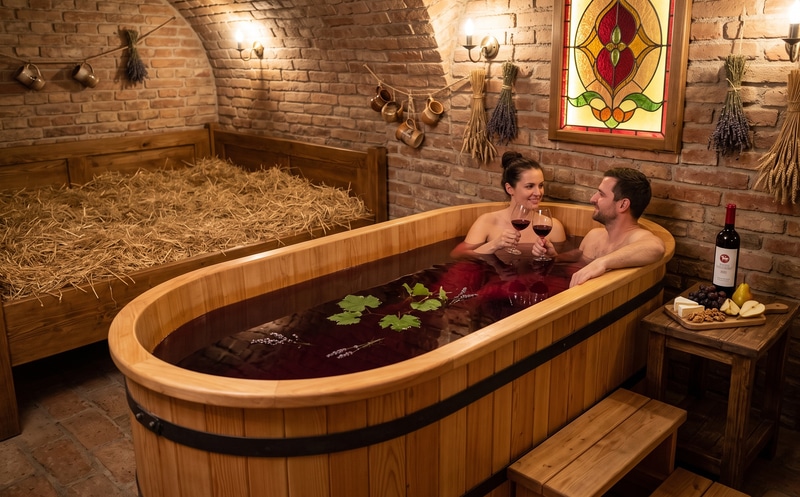
That is exactly why the wine bath holds such a clear place in the offering at Lázně Pramen. It combines red wine, grape seed extract, vine leaf, honey, herbs and French lavender flowers. The bath itself takes place in a handmade tub at 35-38 C and is enhanced by an automatic whirlpool. The ritual includes 20 minutes in the bath followed by 50 minutes of rest on a wheat straw bed, bringing the total stay to 90 minutes. From the point of view of how a treatment is felt, that timing is important - this is not a quick intervention, but a complete experience that gives the body time to slow down.
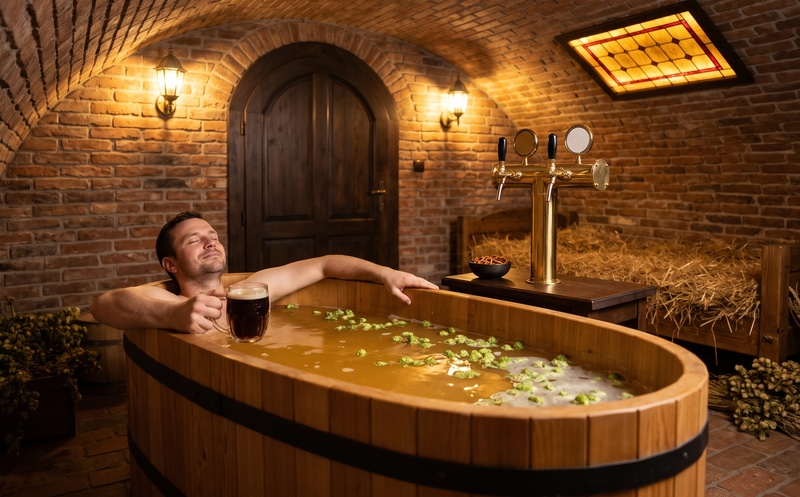
For a couple seeking a more intimate atmosphere, Rubínový pramen is the natural fit - the most private room, designed for 1-2 guests, with a single larch-wood tub and a fireplace. If the aim is more space, or a visit for up to four, Zlatý pramen makes more sense, with two oak tubs with whirlpool. It is also the setting for Combo, which allows a beer bath and a wine bath to be enjoyed side by side in two tubs at the same time. For couples or small groups, that offers a rare chance to compare two distinct rituals in one visit.
In the Czech interpretation, then, wine therapy is not limited to facial care or cosmetic formulation. It belongs to a wider culture of restorative pause. Grapevine shifts from ingredient to atmosphere, from extract to ritual - and that is where its appeal becomes especially persuasive.
When wine care goes deeper: longer rituals and privacy
Not everyone is after a short soak and a straightforward reset. Some guests want more time, more stages and a greater degree of privacy from a wine-based treatment. For them, Smaragdový pramen is the obvious choice - a V.I.P. room for 1-2 guests. It is the only space at Lázně Pramen where all V.I.P. programmes take place, and the only room equipped with a cedar phyto steam cabin. This is not a Finnish sauna, but a compact cabin made from Siberian cedar in which the body sits inside while the head remains outside. Herbal steam acts locally, and the ritual begins in a way that feels quite distinct from a conventional spa circuit.
Smaragdový pramen offers several richer interpretations of wine-led care. V.I.P. Wine SPA for 1-2 guests lasts 2.5-3 hours and includes 15 minutes in the cedar phyto steam cabin, followed by 30 minutes of either a relaxation massage or a body scrub, then the wine bath and a rest period. A bottle of wine and a fruit-and-cheese refreshment are included as well. More specific still is Delux Wine SPA, designed for 1 guest and lasting 2.5 hours. This programme includes the cedar phyto steam cabin, a 20-minute wine peel, a 40-minute wine wrap, a 40-minute full-body massage with grape oil, and a final rest with a glass of wine and a cheese tartlet. It is also the only programme that includes a bathrobe.
These longer rituals show how broad the grapevine theme can become in practice. The bath is only one layer. Heat in the phyto cabin, the preparatory effect of a scrub or wrap, and the slower tempo of massage create a more developed experience than a standard 90-minute visit. It is also worth noting that V.I.P. programmes are always reserved strictly for 1-2 guests, never for larger groups.
For anyone interested in wine-inspired beauty not just as a product category but as a complete care ritual, this is the logical extension. It demonstrates that Czech grapevine-inspired care does not have to end with a cream or a soak. It can become a carefully staged private experience in which each step prepares the next and the idea of wine care is given far more room to breathe.
How to choose wine care by goal, not by trend
One of the most common mistakes in beauty is choosing an ingredient because it is fashionable rather than because it suits an actual need. Grapevine undoubtedly has a strong story behind it, but it only becomes useful when expectations are clear. If you are after light nourishment and everyday skin comfort, products with grape seed oil may be the sensible route. If your interest leans more toward antioxidant-focused care, then formulas rich in polyphenol-containing extracts are likely to be more relevant. And if what you really want is deeper relaxation and a sense of care as experience, a spa ritual will probably make more sense than adding yet another bottle to the bathroom shelf.
This is where a practical approach helps. Not everyone needs the longest programme, and not everyone wants the same level of privacy. For a solo guest or a couple looking for the classic 90-minute visit, Rubínový pramen is an easy choice, with its single larch-wood tub. For 2-4 guests who want more room or the possibility of combining two bath types, Zlatý pramen is the better fit. If the aim is a longer, more layered treatment, then Smaragdový pramen and its V.I.P. programmes come into their own.
A simple breakdown can make the choice easier:
- for a first introduction to wine-based care, the classic wine bath is the right place to start,
- for couples who want to compare two rituals at once, Combo in Zlatý pramen is the most interesting option,
- for guests who want a longer, more private programme, Smaragdový pramen is the dedicated choice,
- and to extend the sense of recovery further, you can add a massage in Safírový pramen.
The important thing is not to let the phrase wine therapy do all the thinking for you. Good wine-based care should be specific, intelligible and proportionate to what you actually want from it. Chosen that way, it stops being a trend label and becomes a useful, lasting part of how you look after yourself, whether at home or in a spa setting.
Why wine care appeals to the senses as well as the mind
Cosmetics never work through composition alone. The feeling they create matters too. Texture, temperature, scent, setting and the amount of time you allow yourself all shape the experience of care in a profound way. Grapevine has an unusually strong position here. It carries cultural associations with calm, ceremony, maturation and a slower rhythm of life. That makes it attractive not just as a source of active compounds, but as a symbol of rest. This psychological dimension is far from trivial. In many cases, it helps explain why people experience wine-based care not as ordinary cosmetics, but as a small ritual.
In a spa environment, that effect becomes even more pronounced. When you sink into a wine bath, you are not only thinking about extracts on the skin. You are also registering the warmth of the water, the gentle movement of the whirlpool, the quiet of a private room and the unhurried rest that follows. At Lázně Pramen, the atmosphere is reinforced by a fireplace and a wheat straw bed in each room. In the more intimate Rubínový pramen, the mood feels especially private, while Zlatý pramen offers more space and a more openly shared ritual.
That shared element matters. Much of everyday beauty care happens quickly and alone. A spa ritual, by contrast, allows care to become time spent together. That is one reason the wine bath works not only as a treatment, but as a pause for couples or close friends. For anyone seeking a longer and more focused version of that experience, a V.I.P. programme in Smaragdový pramen adds the phyto steam cabin and further steps of care to the wine bath itself.
So grapevine in Czech cosmetics resonates not only because of what it contains, but because of what it evokes. It brings together active ingredients, cultural narrative and a particular state of mind. That combination goes a long way toward explaining its enduring place in both products and spa rituals that aim to be more than a technical treatment for the skin.
How to make wine care part of life in a meaningful way
The best skin care is usually the kind that is realistic enough to sustain over time. That is true of grapevine-based care as well. Its value does not lie in one miracle product or a single spa visit, but in the way it offers a clear, pleasurable method of slowing down and giving self-care a little more quality. At home, that might mean choosing products with grape seed oil or vine extracts. In a spa setting, it means allowing yourself a treatment that is longer, more focused and removed from the ordinary pace of the day.
If you want to experience wine care in practice, the most direct route is to book one of the treatments at Lázně Pramen. The starting point is the 90-minute wine bath, available in Rubínový pramen or Zlatý pramen. For guests who want a longer, more layered ritual, Smaragdový pramen offers V.I.P. Wine SPA and Delux Wine SPA. Booking is handled via the website’s reservation page, and if you are buying for someone else, there is also the option of a gift voucher valid for 12 months, allowing the recipient to choose the specific treatment themselves.
Each room has a shower available afterwards, but Lázně Pramen actively recommends not washing off the beer or wine extract with soap for around 2 hours after the treatment. This helps the skin remain soft and comfortably saturated for longer. If you want to expand the visit with another form of rest, you can add a Relax or Sport massage in Safírový pramen, the salt cave lined with 10 tons of salt. Instrument-based lymphatic drainage, however, is not combined with the bath.
So grapevine in Czech cosmetics is more than a handsome editorial theme. It is a living concept that brings together domestic wine tradition, a modern interest in plant-based actives and the need for high-quality rest. That is why it has earned a stable place in contemporary skin care - and why it makes sense to explore it not only through products, but through a carefully composed spa ritual as well. For practical details or individual questions, there is also the contact page. More inspiration on treatments and rituals can be found on the blog, and the full conditions of your visit are available in the terms and conditions.
Sources
- PubMed - Polyphenols and skin photoaging - pubmed.ncbi.nlm.nih.gov
- PubMed Central - Resveratrol and skin health - pmc.ncbi.nlm.nih.gov
- MDPI Antioxidants - Plant polyphenols and skin protection - www.mdpi.com
- PubMed - Grape seed oil composition and cosmetic relevance - pubmed.ncbi.nlm.nih.gov
- NCBI - Overview of oxidative stress and skin ageing - www.ncbi.nlm.nih.gov