Why put beer on your skin at all
Most people picture beer in a glass on the table, not in a jar on the bathroom shelf. Yet hops, yeast and malt have a long history in cosmetics, and it is far more than a marketing gimmick. Break down the raw materials that go into brewing, sort them into their individual active compounds, and you find a surprisingly rich blend: polyphenols, B-group vitamins, amino acids, minerals and polysaccharides. Those compounds are exactly what make beer an interesting raw material for skin and hair, quite apart from whether the finished drink is any good to sip.
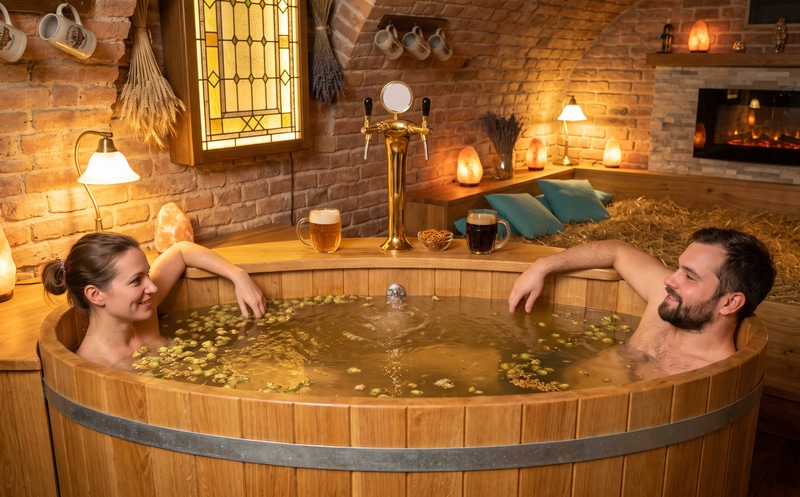
In our spa suites, beer goes into the bath, but its active ingredients also form the backbone of our own cosmetics range. We make it ourselves and sell it at reception: a beer shampoo, a hair conditioner, a body peel, a body scrub and a bath salt. None of it is an afterthought. It is the logical continuation of what happens in the tub during a beer bath. Water at 35-38 °C opens the skin and lets the actives sink in; the cosmetics then carry that care home with you.
This article does not treat beer skincare as a novelty. We focus on one specific question: why a beer bath does not dry the skin out. That means the mildly acidic pH and the acid mantle, malt beta-glucan as a humectant, and what both mean for the skin barrier. What hops, yeast and malt each contain is covered in detail in our separate article on beer cosmetics. The aim is simple: by the end you should understand why ingredients from the brewhouse turn up in cosmetic formulas, and what to expect from them. The science behind each compound is fairly clear once you stop thinking of beer as one thing and start looking at its building blocks. That is precisely what we are about to do.
Hops: polyphenols that soothe and hydrate
Hops (Humulus lupulus) earn their place in brewing thanks to bitterness and aroma, but from a cosmetic angle the real interest lies in their polyphenols and prenylated flavonoids. The best known is xanthohumol, a potent antioxidant that has been the subject of numerous studies for its ability to neutralise free radicals. Free radicals are linked to what scientists call oxidative stress, a process that contributes to premature skin ageing. So in theory the antioxidants in hops help slow the mechanisms by which skin loses its elasticity.
Beyond that antioxidant activity, hop extracts are described as anti-inflammatory and calming. Hops also contain humulone and lupulone, compounds with demonstrated antimicrobial action, which is why hop extracts have historically been studied in connection with irritated, reactive skin. For sensitive complexions there is a further plus: some hop flavonoids appear to help hold moisture in the upper layers of the skin.
- Xanthohumol and other prenylflavonoids act as antioxidants.
- Humulone and lupulone show antimicrobial properties.
- Polyphenols help calm irritated skin.
- Hop essential oils give a distinctive herbal scent with no synthetic fragrance.
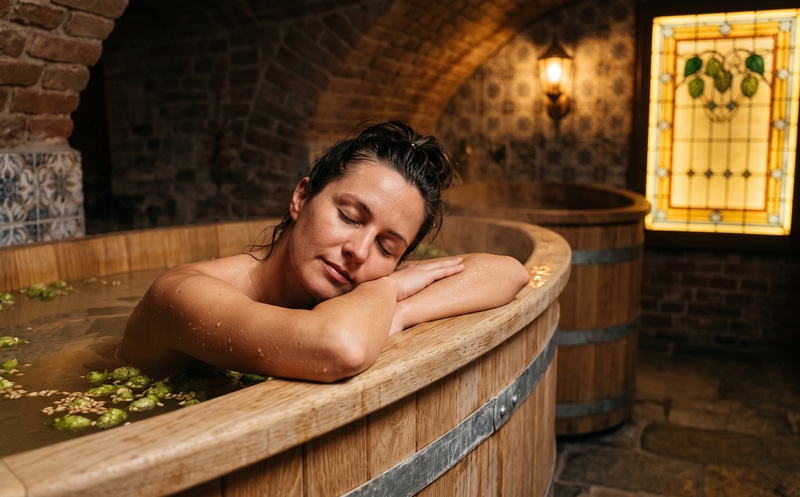
In our beer bath we use Saaz hops, one of the finest varieties in the world, and the same thinking runs through the cosmetics we have made under the Lázně Pramen name since 2008. During the bath the hop compounds release into the warm water and work on the skin for the full length of the treatment. That is also why we suggest not washing the extract off with soap for roughly two hours after you climb out: the actives stay on the skin longer, and guests tell us the hydrating, soothing effect can last a day or two. Hops, then, are not simply a flavour ingredient but a fully fledged cosmetic active with results you can point to.
Brewer's yeast: B vitamins and amino acids
If hops are all about polyphenols, brewer's yeast is the vitamin larder. The yeast Saccharomyces cerevisiae, which turns sugars into alcohol, is nutritionally one of the richest natural sources of B-group vitamins. It carries thiamine (B1), riboflavin (B2), niacin (B3), pantothenic acid (B5), pyridoxine (B6) and biotin, sometimes nicknamed the beauty vitamin for its role in the metabolism of skin, hair and nails.
B vitamins have long been associated in dermatology with supporting the skin's natural defences and its capacity to regenerate. Niacin, or rather its derivative niacinamide, is among the most thoroughly researched cosmetic actives there is, and it is regularly linked to a strengthened skin barrier and a more even tone. Biotin has traditionally been connected with the health of the hair shaft. Alongside the vitamins, yeast also supplies amino acids, the building blocks of proteins, which help the skin retain moisture.
- Vitamins B1, B2, B3, B5, B6 and biotin in a single natural ingredient.
- Amino acids that support hydration and suppleness.
- Minerals including zinc and selenium, both important for skin.
- Nucleotides and peptides that are the focus of ongoing cosmetic research.
During a beer bath we add fresh brewer's yeast, hops and malt to the tub right in front of you, so the mix is as active as possible. That is exactly why the bath is more than an aromatic soak. Anyone who wants to keep the effect going can pick up our beer cosmetics at reception, whose formulas draw on that same yeast. The same principle applies to the wine bath, where grape polyphenols take over the role of vitamins and antioxidants. Yeast, in short, is a concrete reason why beer skincare is not only about scent but carries a genuine nutritional payload for skin and hair.
Malt and beta-glucan: the grain that softens
The third pillar of brewing raw materials is malt, which is barley that has been sprouted and dried. Barley and other cereals contain beta-glucans, soluble polysaccharides prized in cosmetics for their ability to bind water and lay down a fine, hydrating film on the skin. In the scientific literature, beta-glucan is described as moisturising and calming, and as a compound that can form a protective layer on the surface of the skin.
On top of the beta-glucans, malt brings sugars to both the bath and the cosmetics, and those sugars work as natural humectants - substances that draw in moisture. That is precisely why so many guests describe a soft, smoothed feeling to their skin after a beer bath. Malt also holds traces of minerals and antioxidants that round out what the hops and yeast are doing. The result is a genuine synergy: each of the three core ingredients contributes something different, and together they make a complex whole.
- Beta-glucans bind water and support skin hydration.
- Sugars from malt act as natural humectants.
- Grain compounds soften and smooth the skin surface.
- Malt rounds out the antioxidant and mineral profile of the bath.
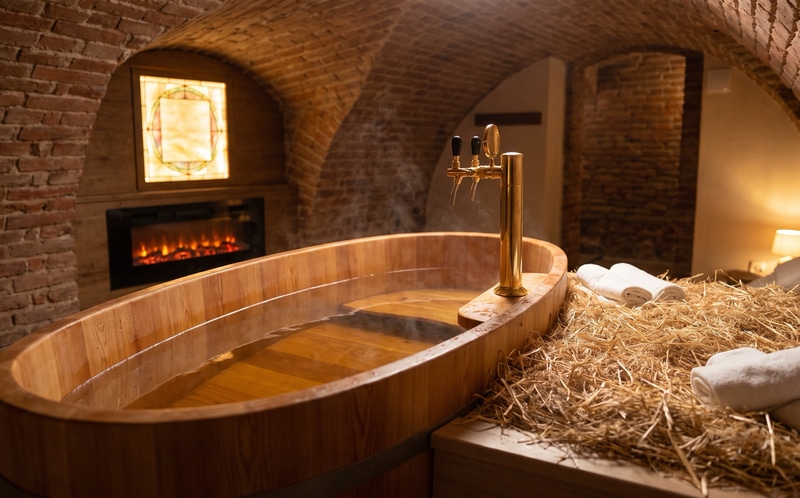
In Zlatý pramen, our most spacious suite with two oak tubs, couples and groups of up to four guests can enjoy a beer bath in its full breadth; the price for this two-tub suite starts at 190 EUR per booking. If you would rather have privacy for two, the more intimate Rubínový pramen, with a single larch tub, offers a beer bath from 148 EUR per suite regardless of how many guests come. Malt completes the picture of why brewing ingredients work not only on the palate but on the skin.
Mildly acidic pH and the skin barrier
Beyond the specific active compounds, one less obvious property of beer plays its part: its mildly acidic pH. Healthy skin carries what is known as an acid mantle, a protective layer with a pH of roughly 4.5 to 5.5 that helps hold in moisture and fend off microorganisms. Many everyday soaps sit at a distinctly alkaline pH, which can disturb that acid mantle and leave the skin dry and irritated.
With its mildly acidic pH, beer is gentler in this respect and works more in step with the skin's natural environment. This is one reason a beer bath tends not to be as drying as a long soak in hot water and ordinary bubbles. The combination of a mildly acidic setting, hydrating beta-glucans and antioxidant polyphenols creates conditions in which the skin barrier does not suffer but instead gets support.
It is exactly why, at Lázně Pramen, we actively recommend not rinsing the beer or wine extract off with soap for about two hours after your treatment. There is a shower in every suite, but if you leave the extract to keep working, guests find their skin stays more supple and better supplied with moisture for a day or two. That one simple step gets the most out of the bath.
- A healthy acid mantle sits at a pH of roughly 4.5 to 5.5.
- Beer's mildly acidic pH respects the skin's natural environment.
- Gentler than alkaline soaps and hot water.
- Leaving the extract on for two hours prolongs the effect.
Acidic pH, then, is not a footnote but part of the explanation for why the beer treatments and the cosmetics work. Anyone who wants to try the whole ritual for themselves can browse our range of treatments and pick the bath that suits them best.
Why beer is good for your hair
Beer and hair is a pairing folk cosmetics already knew: grandmothers swore by a beer rinse for shine and volume. There is real science behind that old trick. Sugars from malt and proteins from yeast form a fine film on the surface of the hair that adds body and reflects light, so strands look glossier and fuller. On top of that, the B vitamins in yeast, biotin in particular, have long been linked to the health of the hair shaft.
The mildly acidic pH of beer helps close the hair cuticle, the outer, scale-like layer of each strand. When the cuticle lies flat, hair frizzes less, builds up less static and reflects light better. It is the same principle used by acidic vinegar rinses, but beer is gentler on both hair and scalp and throws in nourishing extras. The hop polyphenols then bring antioxidant protection to the scalp as well.
- Proteins and sugars form a film on the hair for body and shine.
- Biotin and B vitamins support the health of the hair shaft.
- A mildly acidic pH smooths the hair cuticle.
- Hop antioxidants protect the scalp too.
We have turned that tradition into our own beer shampoo and hair conditioner, both made in-house and sold at reception. So it is not the case that we run the baths and leave hair care to somebody else. Quite the opposite: hair cosmetics are a natural part of what we offer, because brewing ingredients genuinely agree with hair. After a beer bath, or a visit to Smaragdový pramen with its V.I.P. programme, you can take a piece of the ritual home and carry on the care you got used to here. Beer for the hair is one of the oldest natural beauty tips going, and the science backs it up.
From bath to cosmetics: how the two connect
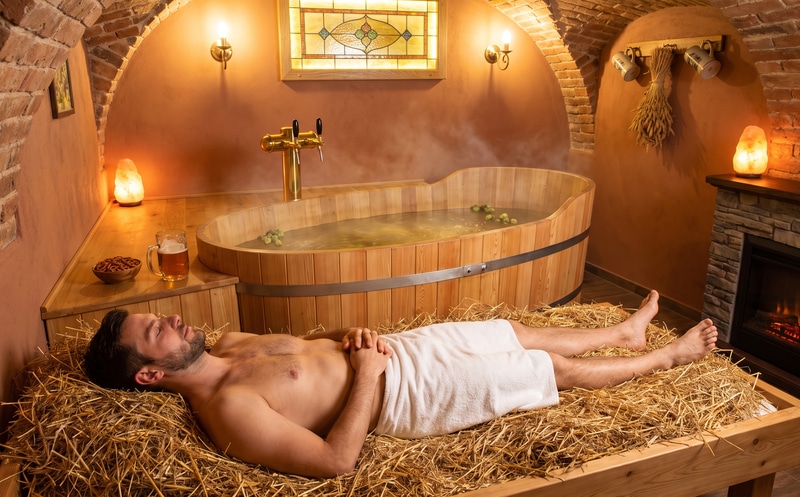
The beer bath and beer cosmetics are not two separate things but two stages of one ritual. The bath is the intense, time-limited part: twenty minutes in the tub at 35-38 °C with hops, yeast and malt, followed by fifty minutes resting on a heated bed of wheat straw. Across that hour and a half the skin absorbs far more of the actives than any everyday home routine could deliver.
At home, the cosmetics take over and keep the effect ticking along between visits. Our range, made under the Lázně Pramen name since 2008, covers a beer shampoo, a hair conditioner, a body peel, a body scrub and a bath salt. Every product draws on the same raw materials you find in the tub, so it is a logical extension of the experience. The peel and scrub lift away dead cells and prepare the skin, the bath salt carries a slice of the spa into your own tub at home, and the shampoo and conditioner look after the hair.
- The bath: intense saturation of the skin over 90 minutes.
- The cosmetics: keeping the effect going between visits.
- The same raw materials in the tub and in the products.
- Peel, scrub, salt, shampoo and conditioner for all-round care.
Anyone who wants to take the experience to the top can book the V.I.P. Beer SPA in Smaragdový pramen, which opens with time in a cedar phytobarrel and a relaxing massage; this programme for one or two guests starts at 293 EUR per booking. Wine lovers can choose the V.I.P. Wine SPA from 326 EUR. If you are after a gift, a digital gift voucher, valid for a year, lets the recipient pick their own treatment. From bath to cosmetics there is a direct route, and at the end of it is skin that remembers the effect for longer than a single visit.
In summary: what makes beer skincare effective
Break beer down into its raw materials and you can see why using it in cosmetics is more than a clever idea. Hops supply antioxidant polyphenols such as xanthohumol, together with anti-inflammatory and antimicrobial compounds. Brewer's yeast delivers a rare combination of B vitamins, amino acids and minerals. Malt enriches the mix with beta-glucans and sugars that bind water and soften the skin. And the mildly acidic pH of the whole system respects the natural protective barrier of both skin and hair.
None of these compounds is miraculous on its own, but their synergy makes sense. That is exactly why brewing ingredients turn up in cosmetic formulas, and why people describe their effect as hydrating, calming and smoothing. At Lázně Pramen we bring both sides together: a bath where the ingredients are added fresh right in front of you, and our own cosmetics range at reception that lets the care continue at home.
- Hops: antioxidants and soothing.
- Yeast: B vitamins, amino acids, minerals.
- Malt: beta-glucans and hydration.
- Mildly acidic pH: kind to the skin barrier.
If you want to put it to the test, start with a beer bath in the intimate Rubínový pramen from 148 EUR per suite, or give a whole group room to spread out in Zlatý pramen. If you prefer the grape, try the wine bath from 201 EUR per suite. After your treatment we suggest not washing the extract off with soap for two hours and letting the actives do their work. You can book through our reservation form, and any questions are welcome via the contact page. Beer skincare works because it rests on the real chemistry of its ingredients, not on a catchy name, and that is a difference your skin can feel.
Sources
- Xanthohumol from hops and its antioxidant and anti-inflammatory effects (PubMed) - pubmed.ncbi.nlm.nih.gov
- Beta-glucans in skincare: hydrating and soothing effects (PMC) - www.ncbi.nlm.nih.gov
- Niacinamide and skin barrier function (PMC) - www.ncbi.nlm.nih.gov
- The skin's acid mantle and the role of pH in barrier function (PMC) - www.ncbi.nlm.nih.gov
- Humulus lupulus: phytochemistry and biological activities of hops (MDPI Molecules) - www.mdpi.com
- Biotin and its role in skin and hair health (PMC) - www.ncbi.nlm.nih.gov