What comes after the bath
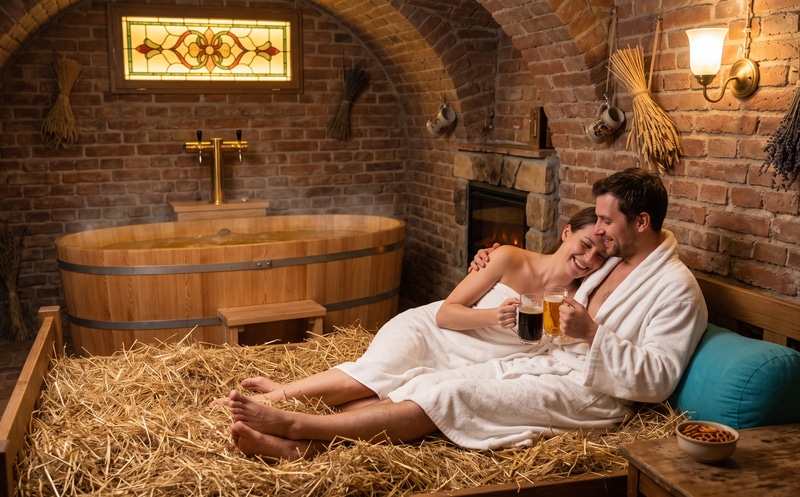
If you are coming to us in Dejvice for the first time, you are probably picturing a wooden tub, a crown of foam, a beer tap within reach and perhaps a little steam. What comes afterwards is unlikely to be part of that picture. Once you step out of the water, instead of a padded lounger, you are shown a wide bed of loose, springy wheat straw. That may surprise you at first, and yes, we mean it. Because this part of the visit is the least obvious, it seems only fair to explain it properly.
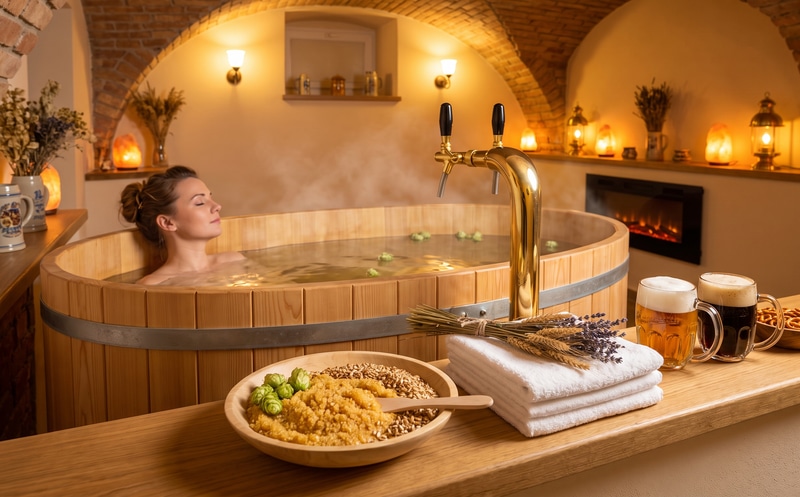
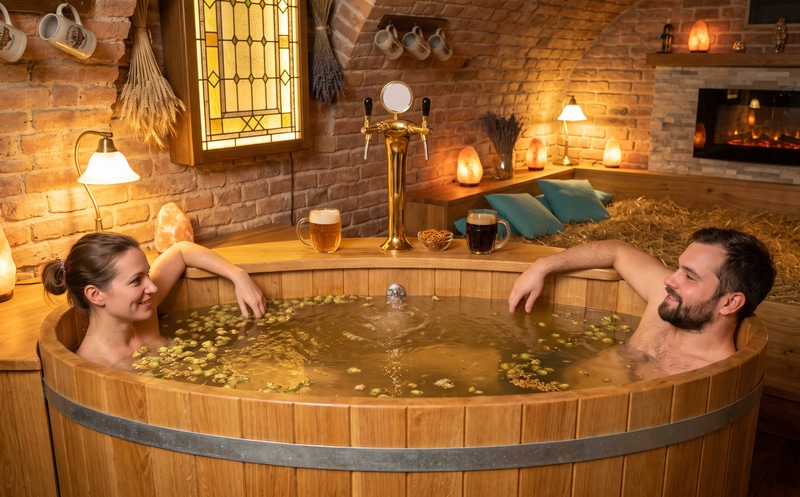
First, the numbers. Both the beer bath and the wine bath give you 90 minutes in the room. Roughly ten of those go on preparation, when the natural blend is added to the water right in front of you. The bath itself, at 35-38 °C and so close to body temperature, lasts 20-30 minutes: usually around twenty, up to thirty if you like. The remaining fifty or so minutes are spent lying on heated wheat straw. Put simply, the rest on the straw takes up more of your time than the soak.
Even so, you may be expecting the kind of upholstered lounger found in hotel wellness areas: a fixed shape, a leatherette or fabric cover, perhaps built-in heating. There is nothing wrong with that. It is simply a different experience altogether. Over the following sections we will explain what loose straw does that upholstery cannot: it breathes, it warms gently and unevenly, it smells of grain, and it keeps your body making small, constant adjustments. We will also be straight about the thing that matters most. For us, straw is a sensory and traditional choice, not a medical one. We claim no healing effects for it, and we will not start doing so here.
What wheat straw is, and how it differs from hay
It is worth starting with the basics, because even these cause confusion. Straw consists of the dry stalks of cereal plants left in the field once the grain has been harvested. That is how Wikipedia defines it, and it is how a review on rice and wheat straw from Wageningen University in the Netherlands describes it too: the stems that remain after the crop is gathered. So this is no specially cultivated material, just the by-product of an ordinary grain field, and something people have been working with for thousands of years.
It is often confused with hay, but the two are quite different. Hay is grass cut while still green and dried as animal feed; it is softer, greener and smells sweet and herby. Straw is dry, pale gold and lighter, and has traditionally been used for bedding, mulch and building. Agricultural sources sum it up neatly: hay is food, straw is a bed. Which is exactly why you lie on straw here, not hay.
The qualities that make straw such a good surface for resting come down to its structure:
- The stalks are hollow, with air both inside and between them.
- It is dry and light, and when loosely fluffed it does not pack down into a solid mass.
- It has a gentle springiness, giving under your weight and partly recovering when you move.
- It carries the soft scent of ripe grain, nothing like the smell of hay.
- It is a natural material, with no seams and no filling.
Straw breathes, upholstery does not
Picture the moment you leave the tub. You have spent twenty to thirty minutes in water at 35-38 °C, your skin is warm, and after a beer bath it still carries a fine layer of the natural blend of hops, malt and brewer's yeast. We suggest leaving it unrinsed for about two hours, so your skin stays smoother for a day or two afterwards. Now you lie down. A leatherette lounger is smooth and sealed: within a few minutes the warmth builds up on its surface with nowhere to go.
Loose straw behaves differently. It is made up of thousands of hollow stalks with air between them, and that air shifts gently with every breath and every movement. Nothing is sealed in, and nothing builds up. Upholstery, by contrast, is designed to be smooth, closed and easy to wipe down. Those are sensible qualities for a hotel relaxation area where dozens of people come and go each day, but they do little for the senses.
It is only fair to say what we are not claiming. We do not suggest that the breathability of straw heals anything or does anything for your skin. It is purely about how it feels to lie there: whether you lie on a smooth, closed surface or an airy, natural one. The difference is obvious in the first few minutes, and the strangeness tends to wear off sooner than you might expect.
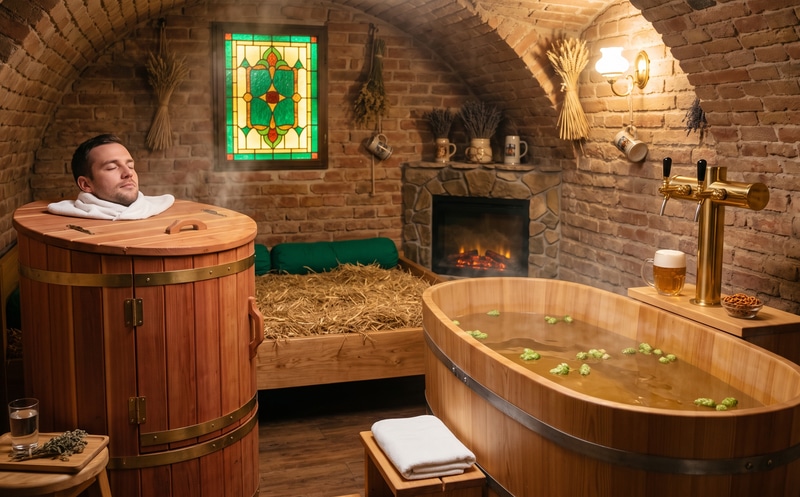
You will find a heated straw bed in all three of our rooms with a tub: in the intimate Ruby Spring (Rubínový pramen) for one or two guests, in the spacious Golden Spring (Zlatý pramen) for two to four guests with its two oak tubs, and in the V.I.P. room, Emerald Spring (Smaragdový pramen). The one exception is the salt cave, which has neither tub nor straw bed, as it is used for massages.
Warmth that is gentle, and never quite even
The second thing straw does differently from a lounger is how it handles heat. The bed is heated, but straw does not pass warmth on the way a metal or plastic panel would. The hollow stalks and the air between them hold the heat and release it slowly and softly. The nearest comparison is lying in a field that has soaked up late-summer sun all afternoon: the warmth rises from beneath you, but it never scorches, and you never feel it as a single hot spot.
Crucially, it is not the same everywhere. Where you sink in deeper, it is warmer; where only a thin layer of stalks lies beneath you, it is a little cooler. Your shoulders may sit at a different temperature from your hips, your feet from your back. A heated lounger with a flat surface would give you perfectly uniform warmth across its whole area. That sounds like an advantage, but in practice the body stops noticing even heat very quickly. The uneven warmth of straw, on the other hand, stays perceptible for the whole rest: gently shifting and pleasantly understated.
Nor does a single source warm the room. The heat comes in several layers that work together:
- the heated wheat straw bed, where you lie for around 50 minutes,
- the bath water at 35-38 °C you have just climbed out of,
- the soft glow of an electric fireplace, with no open flame,
- the warm, low light of lamps that leave the room in a gentle half-dark.
Step out of warm water onto the cool cover of a lounger and you can easily start to shiver. Moving from tub to straw is a smoother transition, because the surface beneath you is already warm and yielding. Again, we are talking about comfort and feeling, not thermoregulation or any therapeutic effect. The straw is not a therapy. It is simply the nicest way we know to let the warmth of the bath fade out slowly.
The scent of grain, the rustle of stalks, the colour of gold
A lounger has no scent of its own, or at most a faint trace of laundry detergent. Straw smells of grain. It is a dry, warm, faintly sweet scent that may remind you of harvest time, a grandparent's barn or the crust of a fresh loaf. Warmed by the bed, it grows a little stronger and quietly fills the room as you rest. Nobody adds it, and there is no fragrance oil involved. It is just the smell of the material you are lying on.
After a beer bath, that scent follows naturally from everything that came before. The malt in the water is made from grain, the hops from the Žatec region bring their own bitter, herbal note, and alongside it all the tap pours unlimited light and dark Petrovické zlato craft beer, with a small selection of snacks. Grain straw beneath your back rounds off the whole story. After a wine bath, with its red wine, grape seed extract, vine leaf, honey, herbs and French lavender flowers, the straw works as a contrast instead: a dry field next to a vineyard.
Then there is the sound. Loose straw rustles softly every time you move. Far from being a distraction, it reminds you where you are and helps set this time apart from lying on the sofa or in bed at home. And finally, the colour. In the warm lamplight and the glow of the electric fireplace, the straw turns golden and individual stalks catch the light. You may take a single photo and then put your phone away.
All of this is sensory, nothing more and nothing less. In our view, scent, sound and colour have no healing job to do. Their only task is to make the fifty minutes of rest something you remember, not a waiting room between the bath and the door.
A body that keeps quietly adjusting
An upholstered lounger has a fixed shape. You lie in it and it holds you in a predetermined position: your back at a set angle, your knees where the hinge falls, your head on the cushion. It is comfortable, but it is a shape you fit yourself into. Loose straw has no fixed shape. It gives under your weight, shifts, parts and then settles again. So your body keeps making small adjustments: a shoulder sinks in slightly, a hip turns, a hand finds a new spot, your legs rearrange themselves.
These little movements may be the least expected thing about straw. They stop you switching off completely, as you would in bed, but they never ask you to do anything either. You may find yourself drifting somewhere between waking and sleep, still aware of your body. After a few minutes, a lounger lets you forget you are lying down at all. Straw gently reminds you, again and again.
We should be precise, though. We are not saying these small movements benefit your spine, your circulation or your muscles. We have no evidence for that, and we will not invent any. We are only describing what feels different about straw compared with upholstery. It is a feeling, not a medical argument.
In all honesty: the senses and tradition, not medicine
So why straw, when a lounger would be easier both to maintain and to explain? The answer is a mix of tradition and the senses. Straw belongs to Czech rural culture as naturally as beer does. For generations it filled the mattresses people slept on and lined stables and barns, and encyclopaedic sources still list bedding as one of its main uses. When we started offering beer baths in 2008, we wanted the whole experience to feel Czech and natural, not like a copy of a hotel spa from anywhere else in the world.
Now for the honest part, which matters to us most. Straw is not a treatment here. It is not therapy, not detox, and not anything with a measurable health effect. We do not want to credit it with qualities we cannot prove, and we will not tell you that fifty minutes on straw will make you healthier. You will, we hope, leave more rested, calmer and with an experience you could not mistake for anything else. That is our whole case.
In the V.I.P. programmes in Emerald Spring, the straw plays the same role, only at the end of a longer, 150-minute ritual. It begins in a cedar phyto-sauna, a cedar barrel you sit in with only your head outside. Then comes a relaxing massage or a body scrub, followed by the bath and finally the rest on the straw bed beside the electric fireplace.
How to enjoy your fifty minutes on straw, and how to book
If the idea of straw still unsettles you more than it tempts you, a few practical pointers may help. These are suggestions, not rules:
- Arrive 10-15 minutes before your booking, so you do not start in a rush.
- After a beer bath, leave the blend on your skin for about two hours; your skin will stay smoother for a day or two.
- Lie down and wriggle as much as you like for the first few minutes; the straw will settle around you.
- Put your phone aside. Fifty minutes is long enough to genuinely switch off.
- Keep a drink to hand: unlimited beer from the tap with the beer bath, a bottle of wine with fruit and cheese with the wine bath.
Prices are always per room, meaning per booking, not per person. A beer bath with one tub for one or two guests starts at €148, and a wine bath with one tub at €201. You can book either in Ruby Spring, Emerald Spring or Golden Spring. Only Golden Spring has two tubs, so the beer and wine bath combination is available only there, from €238 for two guests. The V.I.P. Beer SPA for one or two guests starts at €293. And alongside your rest on the straw, you can follow on with a massage in our salt cave, Sapphire Spring (Safírový pramen).
You will find us at Dejvická 255/18, Prague 6, two minutes from Hradčanská metro station. We are open Monday to Friday 10:00-22:00 and at weekends 10:00-23:00. You can book online through our booking page, by phone on +420 728 059 770 or by email at info@laznepramen.cz. Cancellation more than 48 hours in advance is free of charge. The terms and conditions in force at the time of confirmation apply, and they include a full list of contraindications, such as allergies to any of the bath ingredients.
If you would like to treat someone else to the straw, a gift voucher can be issued for a set amount or for a specific treatment. You will find more articles on how a visit unfolds on our blog. Come and lie down. We promise you will not miss the lounger.
Sources
- Wikipedia: Straw - definition and traditional uses - en.wikipedia.org
- Wageningen University: Rice straw and wheat straw (Bakker et al., 2013) - edepot.wur.nl
- Homestead Gardens: The difference between hay and straw - homesteadgardens.com