Natural or chemical cosmetics: why it's the wrong question
Few corners of skincare stir up as much feeling as the stand-off between natural cosmetics and the so-called chemical kind. Chemist shelves are lined with promises of "chemical-free", "100% natural" and "clean beauty", while social media circulates lists of supposedly dangerous ingredients that must be cleared out of the bathroom cabinet at once. Anyone simply trying to do right by their skin can quickly lose their bearings. Yet the question itself, whether natural or chemical cosmetics are better, is badly framed. Every cream, shampoo and bath salt is a mixture of chemicals, because water, oil, sugar, salt and vitamins are all chemistry. The more useful questions are different ones: what is the product made of, how was it made, how is it preserved, and how does it behave on a particular person's skin?
Lázně Pramen has been working with natural ingredients since 2008. Craft beer, Žatec hops, brewer's yeast and malt go into our wooden tubs in front of the guest; for the wine version, it's red wine, grape seed extract, vine leaves, honey, herbs and French lavender flowers. We also sell our own range of beer cosmetics at reception. Even so, or perhaps precisely because of that, we have no wish to add another catchy slogan to the noise. Day-to-day experience tells us that a natural origin is an interesting trait, not an automatic guarantee of quality, effectiveness or safety. Good care rests on honest ingredients, sensible formulation and an acceptance that every skin reacts a little differently.
So this article takes the subject one step at a time. We'll look at what "natural" and "synthetic" actually mean, how strictly European law governs every cosmetic whatever the packaging says, why even natural products need preserving, and why a herb can irritate skin just as readily as a synthetic fragrance. Then we'll turn to what sets beer cosmetics apart from everyday high-street products, what skin care looks like during a beer bath, and what to look for when you turn a bottle over in the shop and start reading the ingredients. The aim isn't to declare a winner. It's to help you choose next time on the basis of information, not the colour of the label or how green the advertising looks.
Everything is chemistry: what "natural" actually means
In advertising, "chemical" has come to mean something artificial and faintly suspect. Scientifically, that makes no sense. Chemistry is the study of substances and how they change, and quite literally everything we put on our skin or hair is a substance. Glycerin derived from plant oils, lactic acid familiar from soured milk and hyaluronic acid produced by fermentation all have precise chemical formulas. The difference between "natural" and "chemical" cosmetics, then, isn't whether they contain chemicals. It's where those substances come from and how heavily they've been processed before reaching the jar.
In practice, cosmetic ingredients fall roughly into four groups:
- Natural raw materials in their original form - cold-pressed plant oils, honey, dried herbs, sea or rock salt.
- Processed ingredients of natural origin - emulsifiers made from coconut or palm oil, glycerin, gentle sugar-based surfactants.
- Nature-identical substances - certain vitamins or fragrance molecules, for example, made in a laboratory with the same structure they have in the plant.
- Purely synthetic substances with no natural counterpart - silicones, many UV filters, numerous preservatives and polymers.
None of these groups is good or bad in itself. A synthetic ingredient can be exceptionally pure, stable and thoroughly studied, precisely because a manufacturer can produce it to the same standard every time. A natural extract, by contrast, holds dozens or even hundreds of components whose proportions shift with the harvest year, the soil, the weather and the drying method. The same goes for the ingredients we use in the spa: no two hop harvests from the Žatec region, and no two grape harvests, are ever quite alike. That's the beauty of natural materials, but it also demands real care in choosing suppliers.
It's worth knowing, too, that "natural cosmetics" has no single legal definition under European law. Manufacturers can interpret it as they see fit, which is why private certification schemes have emerged, each with its own rules on the share of natural and organically grown ingredients. Yet an ingredient's origin does not, by itself, determine its safety. That simple fact is a good starting point for everything that follows: natural doesn't automatically mean gentle, and synthetic doesn't automatically mean harmful.
How European rules police cosmetics, whatever the label says
People wary of "chemicals" in their cosmetics often have no idea how tightly the EU market is regulated. The cornerstone is Regulation (EC) No 1223/2009 of the European Parliament and of the Council on cosmetic products. It applies equally to a luxury cream from a department store, a shampoo from a discount supermarket and a small handmade range. The regulation draws no distinction between natural and synthetic cosmetics, because from its point of view only one thing matters: any product placed on the market must be safe for human health under normal or reasonably foreseeable conditions of use.
What does that mean in practice? A set of obligations that every manufacturer must meet, without exception:
- Every product in the EU has a responsible person who answers for its safety.
- Before it goes on sale, a qualified expert must carry out a safety assessment, and the manufacturer must keep a product information file.
- The product is notified to the central European portal for cosmetic products.
- The annexes to the regulation list prohibited substances and restricted ones, along with permitted colourants, preservatives and UV filters.
- Ingredients are listed using the international INCI nomenclature, in descending order of concentration.
- Certain fragrance allergens must be named individually once they exceed a set threshold.
For consumers, that leads to an important conclusion. A preservative you find in an ordinary shampoo has been assessed and approved up to a specific maximum concentration. A "paraben-free" or "chemical-free" label, on the other hand, tells you nothing on its own about whether a product is any gentler. In its follow-up rules on cosmetic claims, the European Commission requires marketing statements to be truthful, backed by evidence and not to denigrate competing products that comply with the law. A "free from" claim only makes sense when it gives the consumer genuine information, for instance to someone with a proven sensitivity to a specific substance.
The framework applies just as much to large multinational brands as to small producers working with beer, wine or herbs. A small range isn't somehow "outside the system", and a big brand isn't suspect just for being big. The real differences tend to lie in the story, the scale of production, how quickly the range changes and how close the maker is to their raw materials. Before we get to what makes beer cosmetics interesting, though, a word on the ingredient people fear most.
Preservatives, allergens and the myth of harmless nature
Preservatives are among the most common charges laid against "chemical" cosmetics. But any product containing water is an ideal home for bacteria, moulds and yeasts. You open a cream or shampoo dozens, even hundreds of times; fingers go into it; it sits in a warm, damp bathroom. Without effective preservation, microorganisms could multiply in it within a few weeks and do your skin far more harm than an approved preservative at a low concentration. Truly preservative-free products are therefore either water-free, like oils, salts and some scrubs, or they have a very short shelf life and need to be kept cool.
The second myth holds that natural substances can't cause allergies. The opposite is true. Contact dermatitis, an inflammatory skin reaction after contact with a particular substance, comes in two forms. Irritant dermatitis occurs when a substance directly damages the skin barrier, typically through frequent washing and contact with harsh cleaning products. Allergic dermatitis is an immune response to a substance the skin has previously become sensitised to. Specialist sources list fragrances, preservatives, certain metals and plants among the common triggers. A plant extract is just as foreign to the skin as a synthetic molecule, and a natural fragrance blend may contain exactly the allergens that European rules require to be named on the packaging.
What does that mean day to day? A few principles that hold whether you're buying a natural or a conventional product:
- Try any new product on a small patch of skin first, such as the inner forearm, and watch for a reaction over several days.
- If you know you're sensitive to a particular substance, look for it in the INCI list, not in the marketing promises on the front.
- The more ingredients a product contains, the greater, in theory, the chance you'll react to one of them.
- Heavily fragranced products cause problems more often than unscented ones, regardless of where the scent comes from.
All of this applies to beer, hops, yeast and wine too. They are lovely ingredients with a long tradition, but they remain biologically active material. That's why we speak about them with respect, and why our guests see exactly what goes into their tub. We consider transparency one of the most important qualities of genuinely honest care.
Beer cosmetics: what sets them apart from the high street
Beer is as much a part of Czech identity as Prague Castle, so it's hardly surprising that brewing ingredients have found their way into body and hair care. Hops, malt and brewer's yeast have been part of daily life here for centuries, and the pairing of beer and bathing has a long history in Bohemia. For us, beer cosmetics are the natural continuation of what happens in the tubs: we want guests to be able to take a little of the spa home with them and keep up the ritual through an ordinary week.
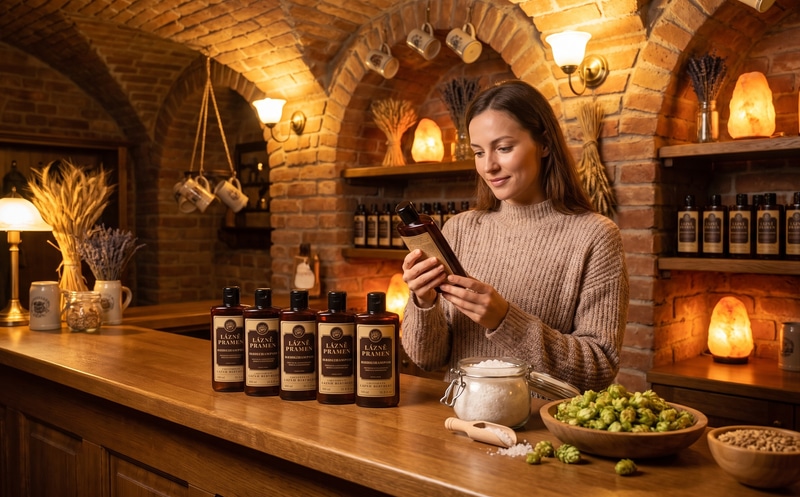
Our own range of beer cosmetics, which we make ourselves and sell at reception, has exactly five products:
- beer shampoo,
- hair conditioner,
- body peel,
- body scrub,
- bath salt.
Between them they cover both hair and body. The shampoo and conditioner are for everyday washing, the peel and scrub for regular body care, and the bath salt for evenings when you want to draw your own relaxing bath at home. We don't publish prices online; we'd rather show you the current range at reception, where you can look at the products, smell them and ask anything you like. These are retail products, not a treatment, so you can buy them without booking a bath.
So how does this kind of range differ from what you'd find in a big chemist chain? Mainly in scale and in its relationship with the ingredients. A large manufacturer optimises its formulas for millions of units, for stability over long-distance shipping and for a uniform scent in every country. A small range that grows out of the spa's daily work stays close to what we use in our treatments and to the people who use it.
It's only fair to say what beer cosmetics are not. They aren't a miracle cure, they don't replace dermatological care, and they aren't "chemical-free", because no such product exists. Like every cosmetic on the European market, they are subject to exactly the same rules as any other shampoo or scrub. Their added value lies in the story, the link to the Czech brewing tradition and the chance to keep your spa visit going at home. And if you'd like to see brewing ingredients at work, there's the beer bath.
Seeing is believing: beer and wine baths in practice
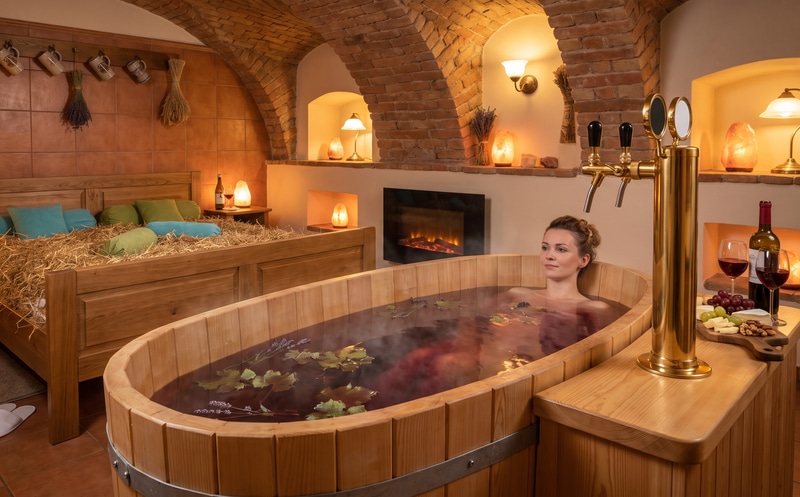
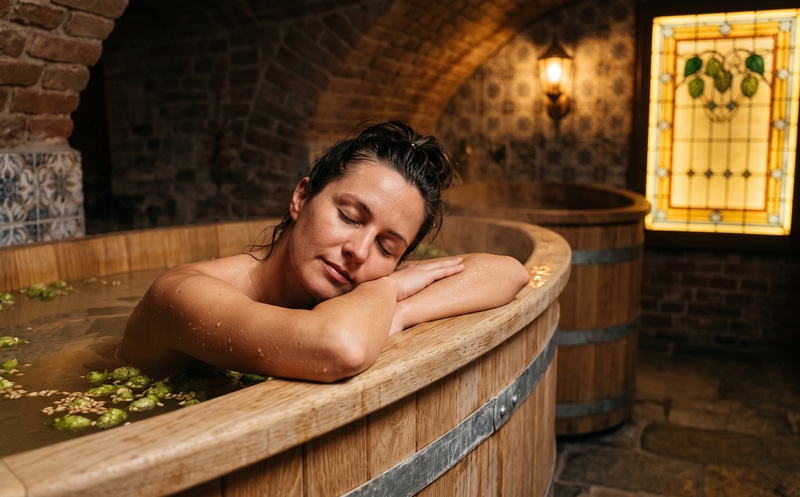
With bottled cosmetics, you read the label. With a spa treatment, you watch it happen. For the beer bath, a blend of Petrovické zlato craft beer, Žatec hops, brewer's yeast and malt is added to a handmade wooden tub right in front of you. The water sits at 35-38 °C, close to body temperature, and the tub's whirlpool jets keep it gently moving. There's a beer tap in the room, so you can pour yourself as much light and dark beer as you like throughout your visit, and a small snack comes with it.
The whole visit lasts 90 minutes and follows a clear shape. Around 10 minutes go on preparation, as a member of staff talks you through what happens and prepares the bath before your eyes. You then spend 20-30 minutes in the tub, usually about twenty, or up to thirty if you prefer. The remaining 50 minutes or so are for resting on a heated bed of wheat straw beside an electric fireplace, whose warm glow sets the mood. The intimate Ruby Spring (Rubínový pramen), with its larch tub, is ideal for one or two guests. The beer bath starts at €148 per room, not per person, so a couple sharing a tub pays the same as a single guest.
The wine bath follows the same pattern, swapping the brewing ingredients for red wine, grape seed extract, vine leaves, honey, herbs and French lavender flowers. For one or two guests it starts at €201 per room and includes a bottle of wine and a plate of fruit and cheese. If you're coming as a larger group, or simply can't decide between beer and wine, the spacious Golden Spring (Zlatý pramen) has two oak tubs side by side. A combined beer and wine bath for 2-4 guests costs from €238 per room, two beer tubs from €190 and two wine tubs from €268.
One piece of advice links both treatments and sums up how we think about skin care. Every room has a shower, but we recommend not rinsing off the beer or wine blend for about two hours. Your skin stays smoother and better nourished for a day or two after your visit. No bottle can give you quite the same thing as that moment when an ingredient is simply given time to work.
How to read an ingredients list and choose with a clear head
Whether you lean towards natural or conventional cosmetics, your most valuable tool is the back of the pack. At first glance an INCI ingredients list looks like a cipher written in Latin and chemistry, but a few basic rules will get you reading it quickly. Ingredients appear in descending order of concentration, so the first three to five make up most of the product. Anything present at less than one per cent can be listed in any order at the end. So if the front of the bottle promises "with hop extract" and you find it at the very bottom of the list, it's more of a garnish than a main ingredient.
A practical approach might look like this:
- Ignore the front of the pack at first. Words such as "natural", "clean" or "chemical-free" have no single legal definition.
- Read the first five ingredients. They tell you what the product is really made of, whether water, oil, surfactant or salt.
- Look for the word "parfum" and any named allergens. If your skin is sensitive, these are the first places to look for possible triggers.
- Check the open-jar symbol. The number followed by the letter M tells you how many months the product is good for once opened.
- Verify the certification, if it matters to you. Private certification schemes have their own rules, and they can be looked up.
- Try the product on a small patch of skin. No label can stand in for your own skin's reaction.
It also helps to think about the type of product. A shampoo or shower scrub is rinsed off within minutes, while a cream or body lotion stays on your skin for hours. That's why European rules set different thresholds for rinse-off and leave-on products, for example when it comes to listing fragrance allergens. If your skin is sensitive, it pays to be more cautious with leave-on products and to choose simpler formulas.
And finally, a piece of advice that sounds trite but works: less is often more. Your skin doesn't need ten layers and five active ingredients at once. A simple routine built around a good cleanser, a gentle scrub once or twice a week and proper hydration covers most needs. Whether individual ingredients are natural or synthetic is a secondary question. What matters is whether the routine suits you, and whether you can stick to it in the long run.
From label to bathtub: the ingredients up close
You could argue about natural versus chemical cosmetics in theory for ever. Far more interesting is finding out what your skin actually likes. If you want to meet brewing and winemaking ingredients in their most direct form, Lázně Pramen is at Dejvická 255/18 in Prague 6, a two-minute walk from Hradčanská metro station. We're open Monday to Friday from 10:00 to 22:00, and at weekends from 10:00 to 23:00. All our rooms are private, so your treatment happens in a space that's yours alone.
For those who want more than the classic bath, there's the V.I.P. Emerald Spring (Smaragdový pramen). A visit here lasts two and a half hours and begins in a cedar phyto-sauna: a cedar barrel in which your body sits in steam from herbal infusions while your head stays outside. The V.I.P. Beer SPA package for one or two guests continues with a relaxing massage or body peel, a beer bath and time to rest, from €293 per room. The V.I.P. Wine SPA follows the same pattern with a wine bath, a bottle of wine and a plate of fruit and cheese, from €326. The Delux Wine SPA is designed for a single guest and brings together the cedar barrel, a wine peel, a wine wrap, a full-body massage with grape seed oil and a rest by the fireplace with a glass of wine. It's the only package that includes a bathrobe, and it costs from €326.
If you'd rather have calm surroundings without a tub, try the Sapphire Spring (Safírový pramen) salt cave, lined with ten tonnes of rock, Dead Sea and Himalayan salt. This is where our massages take place: a 30-minute relaxing back, neck and shoulder massage from €33, a one-hour full-body relaxing massage from €50 and a sports massage from €75. Each works as a visit in its own right or alongside a bath.
After your treatment, stop by reception to browse our beer cosmetics and carry on the ritual at home. If you'd like to give the experience to someone else, choose a gift voucher and let them pick their own treatment. You can book online on the all treatments page, and any questions can go through our contact page. A full list of situations in which we don't recommend our treatments, including allergies to their ingredients, can be found in our terms and conditions.
Sources
- Regulation (EC) No 1223/2009 on cosmetic products - eur-lex.europa.eu
- European Commission: cosmetics - single-market-economy.ec.europa.eu