When your head refuses to cooperate
Headaches are among the most common complaints anyone will run into over a lifetime. According to summaries from the World Health Organization, a large share of the adult population lives with recurring headaches, and the tension-type variety is by far the most widespread. Migraine is a separate, genuinely disabling category, one that can take a person out of a normal day for hours or even days. From the outside the two states can look alike, but they run on different mechanisms, and it matters not to mix them up.
People looking for relief tend to reach for some combination of medication, quiet and warmth. And it is precisely quiet, warmth and the deliberate release of tight muscles that a well-tuned spa setting can offer. We are not about to claim that a warm bath cures migraine or stands in for a neurologist. What we do want to lay out honestly is what heat and deep relaxation actually do to muscles and the nervous system, when that can help, and when it is wiser to put the bath off for another day.
In this article we look at the difference between a tension headache and a migraine, at how warmth in the 35-38 °C range works, at the role of releasing the neck and shoulder muscles, and at how a hushed, quiet environment affects the nervous system. We explain why, for some people, migraine is triggered by overheating rather than eased by it, and what to do about that. And at the end we sketch what a carefully planned visit to our private rooms might look like so that it helps your head rather than hurts it. The aim is to give you enough to decide for yourself, with open eyes. Headaches are individual: what soothes one person can be the very trigger that sets off another.
Tension headache versus migraine: what actually differs
Before we get to warmth and relaxation, it pays to work out which kind of pain you are dealing with, because the right approach depends on it. A tension headache tends to be described as a dull, two-sided, gripping pressure, as though a headband had been pulled a size too tight. It often starts in the neck, shoulders and temples, and it is tied to muscular tension, long hours slumped at a computer, poor head posture and stress. This is the type that warmth and muscle release tend to help most.
Migraine is another animal. It is typically one-sided and throbbing, comes with sensitivity to light and sound, sometimes nausea, and for some people is preceded by an aura, a temporary disturbance of vision or sensation. Migraine has a neurological basis, and its triggers are highly personal: too little sleep, hunger, dehydration, hormonal shifts, certain foods, strong scents, bright light and, for a subset of sufferers, marked warmth or heat. That is why migraineurs need the caution we set out further on.
- Tension headache: two-sided, a dull gripping pressure, linked to muscle tension and stress.
- Migraine: often one-sided, throbbing, with sensitivity to light and sound, sometimes aura and nausea.
- Tension headache often responds well to warmth, stretching and releasing the neck muscles.
- Migraine has individual triggers, and for some people overheating is one of them.
- Recurring or worsening headaches are a matter for a doctor, not a spa.
This split is a simplification, and in real life the two can overlap. The key message is this: if your headache fits the tension type, bound up with strain and stress, then a calm, warm setting and some muscle release can be a pleasant and sensible choice. If it is a true migraine, treat warmth with care and lean towards the quieter, cooler, less intense way of resting.
What warmth does for tight muscles and a busy mind
Warmth is one of the oldest and best-studied ways to ease muscular tension. Slip into water of roughly 35-38 °C and the surface tissues warm gently, blood vessels widen and circulation improves. Muscle that is warm and well supplied with blood lets go more easily, so the tightness across the neck and shoulders that lies behind so many tension headaches can begin to loosen. Review work on thermotherapy and physical medicine describes local heat as helping to lower muscle tone and the pain a person subjectively feels in tension-related complaints.
Beyond the purely physical, the mind plays its part. Warm water and a calm setting nudge the nervous system into its resting mode, in which the parasympathetic branch, the side that settles the body, takes over. Breathing slows, the sense of strain eases, and the clenched jaw and hunched shoulders begin to soften. Since chronic stress and the constant muscle bracing that comes with it are among the main contributors to tension headaches, deliberately inviting that calm genuinely matters.
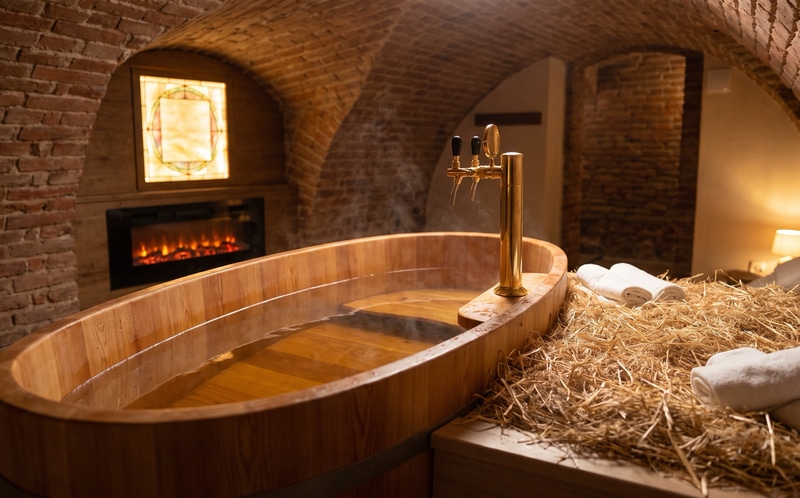
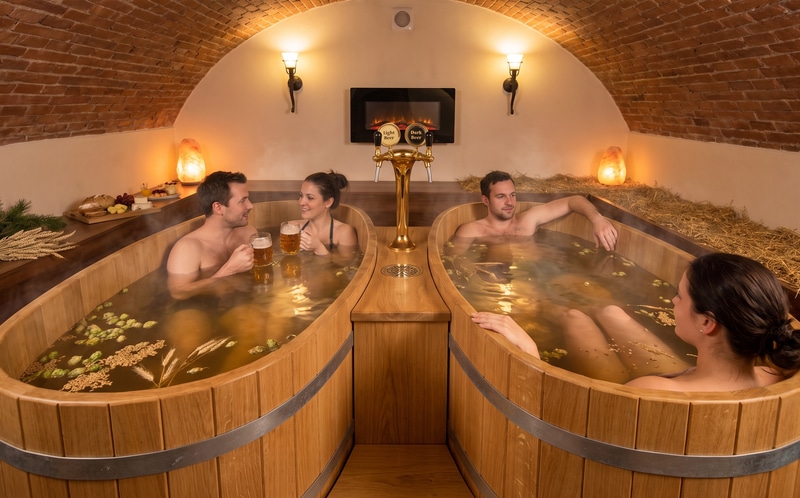
Our beer bath and wine bath are built on exactly this principle. The tub is filled by hand with water in the 35-38 °C range, enriched with natural ingredients and softly whirled. The soak itself lasts around 20 minutes, and then comes the part that really counts: roughly 50 minutes of rest on a heated bed of wheat straw. All told the treatment runs about 90 minutes. A beer bath for one or two guests sharing the same tub starts from 148 EUR per booking; a wine bath, with a bottle of wine in the room, from 201 EUR per booking. It is that quiet finish, as the body slowly cools and the mind settles, that often matters more to your head than the bath itself.
A calm room as medicine for an overloaded head
Migraine and tension headache share a common enemy: sensory overload. Harsh screen light, the noise of open-plan offices, the endless drip of notifications and the impossibility of switching off for a moment all keep the brain permanently on edge. One of the simplest and yet most effective things to do when a headache starts to build is to retreat into a hushed, dimly lit space and let the senses rest. Studies of migraine triggers name sensory overload and lack of calm again and again as significant factors.
That is exactly why a room designed on purpose to be private and quiet is worth considering. In our private rooms you share the space with no strangers, nobody walks past you, no phones ring, and the light is dimmed and warm. The fireplace is electric, giving off only a soft glow with no real flame, so there is no smoky smell and no sharp light of the kind that can set off a migraine. The warmth in the room comes from the heated straw bed, from the warm water and from the gentle light of the lamps.
For anyone after complete calm, alone or as a pair, the most intimate choice is Rubínový pramen, a snug room with a single larch tub. Those who prefer more space can opt for Zlatý pramen, with two tubs. The crucial thing is to set expectations: if you are prone to headaches, the point of a visit like this is not boisterous drinking and noisy fun but silence, slowing down and conscious release. We suggest arriving with plenty of time in hand, hurrying nowhere, drinking water and giving your full attention to the resting phase. It is the mix of privacy, low light and warmth that creates the conditions in which an overloaded head gets a chance to recover.
Neck massage and the salt cave: targeted relief
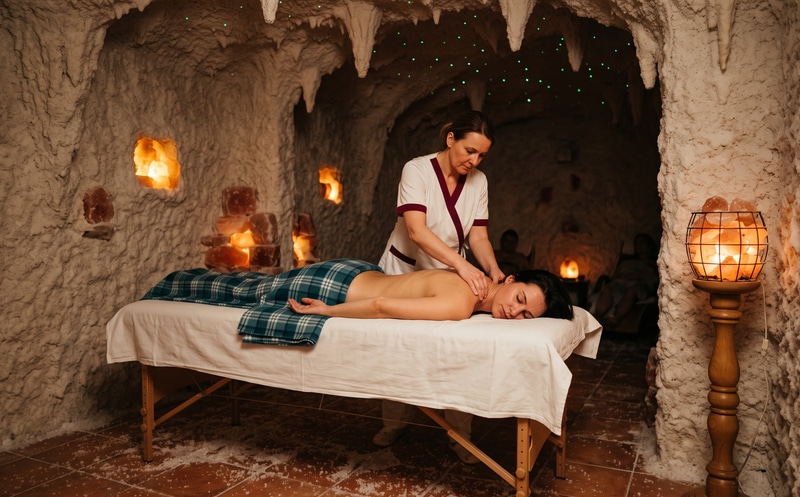
Where a bath works on the body as a whole, massage lets you go straight to where the tension is born. With tension headaches that is most often the neck, the nape, the upper back and the shoulders. A gentle, releasing massage of these areas can lower muscle tension, improve circulation and ease, at least as you feel it, the pressure that shoots up into the head. Reviews of manual therapy for tension headaches suggest that working on the tight muscles of the cervical spine may help some patients reduce both how often and how severely the trouble strikes.
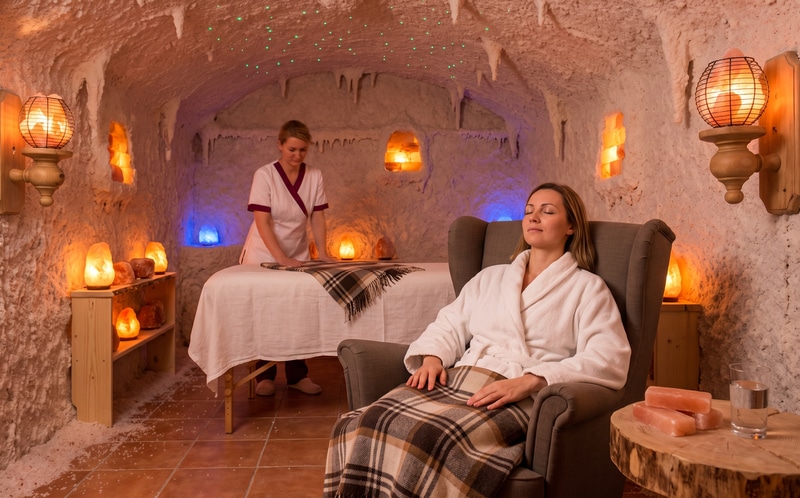
In our Safírový pramen, a salt cave built from ten tonnes of three kinds of salt, we offer relaxation and sports massage. A 30-minute relaxation massage of the back and neck starts from 33 EUR, a 60-minute full-body relaxation massage from 50 EUR, and a deeper 60-minute sports massage from 75 EUR per guest. The salt cave adds a calm atmosphere of salt lamps and low light, which suits anyone sensitive to bright light far better than a starkly lit clinic room.
- Relaxation massage, 30 min from 33 EUR: targeted work on the back, neck and shoulders.
- Relaxation massage, 60 min from 50 EUR: releasing the whole body and slowly settling the mind.
- Sports massage, 60 min from 75 EUR: deeper work on chronically tight muscles.
- Salt-cave setting: low light and calm, kind to sensitive senses.
An important word for migraineurs: a massage done too vigorously, or a long treatment in the warmth, can for some people actually help bring on an attack. So tell our therapists in advance that you are prone to headaches, and agree on a gentler, shorter approach. If headaches trouble you often or are getting worse, diagnosis and treatment always belong in a doctor's hands. Think of massage and a calm room as an add-on to your wellbeing, not a medical remedy.
When warmth does harm instead, and how to stay careful
Here we have to be honest and plain. The very warmth that helps a tension headache can, for some people with migraine, be the thing that triggers it. Overheating the body, sharp swings in temperature, dehydration and losing fluid in the heat are all among the documented migraine triggers. Which means a long stay in a hot bath or time in an overheated room can, in a sensitive person, not ease a headache but provoke one. That is why we never claim a bath treats migraine.
So how do you go about it sensibly? If you know you react to heat, favour the calmer, less thermally demanding treatments, such as a shorter massage in Safírový pramen rather than a long hot bath. If you still want to try a bath, stay in the tub only as long as you truly need, drink plenty of water before and after, avoid sudden jumps in temperature, and stop the treatment at the first signs of an approaching migraine. Listen to your body, not to the urge to finish everything.
There are also situations in which a bath is simply not suitable at all. Our terms and conditions, specifically the clause on contraindications, list the groups for whom baths and massages are not recommended, among them cardiovascular disease, pregnancy, acute inflammation and fever, open wounds and skin infections, epilepsy, and allergies to the ingredients used. If your headaches come with neurological symptoms, are new, suddenly severe or getting worse, see a doctor first, always. A spa visit is a form of rest and care for your wellbeing; it is no substitute for a neurological work-up or for the acute treatment of migraine. We hold to that line on purpose, because our guests' health comes first and we have no wish to offer false hope.
How to plan a visit so it does your head good
Once you have decided on a calm spa visit as part of caring for your wellbeing, it is worth planning it to maximise the calm and minimise any possible triggers. The first rule is time without haste. Arrive with a margin to spare, do not schedule a meeting right on the heels of it, and expect to want a slow return to your usual pace afterwards. The nervous system needs a transition, not an abrupt flick back into the bustle.
The second rule is hydration and a light meal. Hunger and dehydration are classic migraine triggers, so never turn up for a treatment on an empty stomach or completely parched. Drink water before and after. If you are pairing the bath with a drink, keep it moderate, because alcohol is in itself a headache trigger for some people. The point of this visit is calm, not a lavish feast.
- Arrive with time in hand and plan nothing for immediately afterwards.
- Drink water before and after your visit, and do not come on an empty stomach.
- Be sparing with alcohol at the bath; for sensitive people it is a trigger.
- Tell the staff in advance that you are prone to headaches.
- Leave the bath extract on your skin for about two hours without soap, and it stays soft and supple.
- As a pair, choose Rubínový pramen; for more calm and space, Zlatý pramen.
Booking is easy through the reservation form on our website, where you pick a date, the number of guests and the type of treatment. Prices are always for the whole room, never per person, so a beer bath for two costs the same as for one, from 148 EUR per booking. If you would rather keep your calm visit for a better day, when you feel well, there is a gift voucher valid for twelve months, with the recipient choosing both date and treatment. That is genuinely handy for anyone with headaches, since you get to pick a day when you feel fine and enjoy the treatment in better conditions. Any questions, and you can reach us any time through the contact page.
Give your head some quiet at the spa
Headaches are a subject where we have no interest in promising miracles. A warm bath, a releasing massage and a calm private room will not cure migraine, nor stand in for a neurologist. What they can offer is a meaningful blend of three things that do a worn-out head good: warmth that loosens the tight muscles of the neck and shoulders, a hushed setting free of sharp light and noise, and a conscious slowing in which the resting side of the nervous system takes over. For tension headaches born of strain and stress, that can be a pleasant and worthwhile way to look after yourself.
The key is judgement. If you are one of those for whom heat triggers migraine, lean towards the calmer, less thermally demanding treatments, keep an eye on your fluids, and stop the treatment at the first symptoms. If your headaches come with warning neurological signs or are getting worse, your first steps belong at a doctor's, not at a spa. And if you fall into any of the groups named in our terms and conditions, do not skip the conversation with your doctor.
For anyone after a quiet evening full of calm, our treatments await in private rooms: the intimate Rubínový pramen for one or two guests, with a beer bath from 148 EUR or a wine bath from 201 EUR per booking; the roomier Zlatý pramen for up to four guests; and targeted massages in the Safírový pramen salt cave from 33 EUR. You will find us at Dejvická 255/18 in Prague 6, just two minutes from Hradčanská metro station, open every day. Book your slot through our reservation form, or drop us a line via contact. Give your head the quiet it deserves, and do it wisely, with an eye on how your own body reacts.
Sources
- World Health Organization: Headache disorders - fact sheet - www.who.int
- Mayo Clinic: Tension-type headache - symptoms and causes - www.mayoclinic.org
- Mayo Clinic: Migraine - symptoms, causes and triggers - www.mayoclinic.org
- Petrofsky J. et al.: Effect of heat and cold on tendon flexibility and force to flex the human knee (PMC) - www.ncbi.nlm.nih.gov
- Chaibi A., Russell M.B.: Manual therapies for primary chronic headaches - systematic review (PMC) - www.ncbi.nlm.nih.gov
- Pescador Ruschel M.A., De Jesus O.: Migraine Headache (StatPearls, NCBI Bookshelf) - www.ncbi.nlm.nih.gov