Why joints respond well to warmth and stillness
When people think about looking after their joints, the mind tends to go straight to physiotherapy, exercise regimes or medication. All of those matter. But so does something less obvious: the body's ability to release the protective tension it builds up around sore or stiff areas. A joint does not exist in isolation. It is wrapped in muscle, tendon, fascia and blood vessels. When chronic tension holds in the surrounding tissue, movement becomes guarded and less fluid - and the whole problem can feel considerably worse. That is why it makes sense to talk about spa not as a substitute for treatment, but as a sensible part of a recovery approach that supports comfort, ease and a better subjective sense of movement.
Warm water immersion has long been associated with relief from stiffness. Research consistently describes how heat can help release muscular tension, improve local circulation and raise the tolerance for movement. For people dealing with morning stiffness, fatigue from prolonged sitting or post-exercise soreness, a regular restorative ritual makes practical sense. At Lázně Pramen that means privacy, a stable water temperature of 35-38 degrees Celsius, quiet surroundings and a clearly structured session that includes both the bath itself and a proper rest period afterwards. That last point matters: the effect of warmth tends to be considerably stronger when it is followed by a period of stillness, rather than an immediate return to cold air, stress and a cross-city commute.
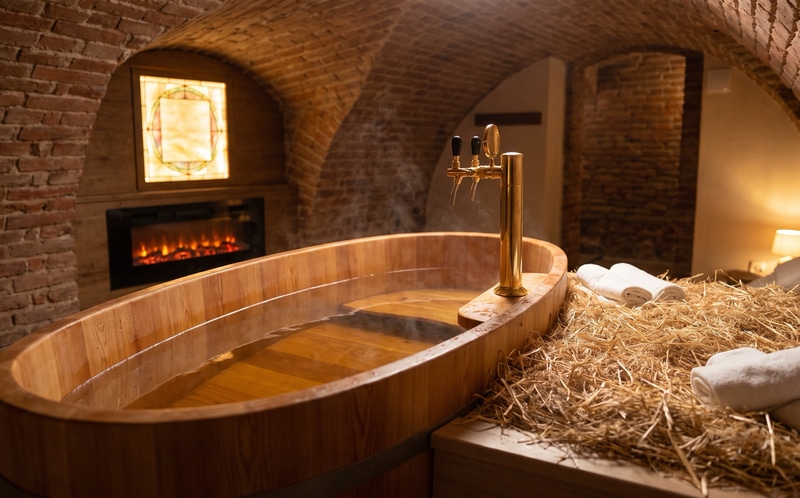
If you are looking for a gentle starting point, the natural choice is a private beer bath or wine bath. For one or two guests, both are typically held in Rubínový pramen - the most intimate of the rooms, designed precisely for an unhurried stay. Pricing is per room rather than per person. A beer bath in a single tub starts from €148 per visit; a wine bath from €201. For many couples or individuals, this is the most natural way to combine warmth, proper rest and time that belongs entirely to them.
Realistic expectations matter here too. A spa visit will not restore worn cartilage to its original state, and it is not a replacement for diagnosis or a medically supervised plan. What it can do is create conditions in which the body resists movement less, the muscles around stiff joints release their grip, and a person briefly stops functioning in a state of constant bracing. In the context of joint care, that is worth considerably more than it might initially sound. Most people are not looking for a dramatic transformation in sixty minutes. They are looking for a place where breathing feels easier, sitting feels better, getting up feels less effortful - and where they leave feeling lighter rather than merely tired.
How a warm bath works in practice
The effect of a warm bath goes beyond comfort. When the body enters water held at 35-38 degrees Celsius, a handful of practically relevant things happen. Heat helps dilate peripheral blood vessels, improve tissue circulation and reduce the sense of muscular guarding around stressed joints. Water also unloads the body in a way that no dry environment can quite replicate. Although Lázně Pramen is not a hydrotherapy clinic, simply lying in the tub brings many guests relief from the cumulative pressure they carry in their lower back, hips, knees or shoulders through the course of a normal day. Add a quiet room, lowered lighting and the absence of external noise, and the nervous system receives a clear signal that it can ease off.
There is one important distinction worth making before you book. Warm water suits chronic stiffness and tired muscles; it is not the right answer for a joint that is acutely inflamed. If a joint is swollen, hot to the touch or red, or you are in the middle of a flare of an inflammatory condition such as rheumatoid arthritis or gout, a hot bath can make matters worse. In that acute phase, cold tends to be more appropriate, and it is better to wait until things have settled before coming in. If you are at all unsure, check with your doctor first.
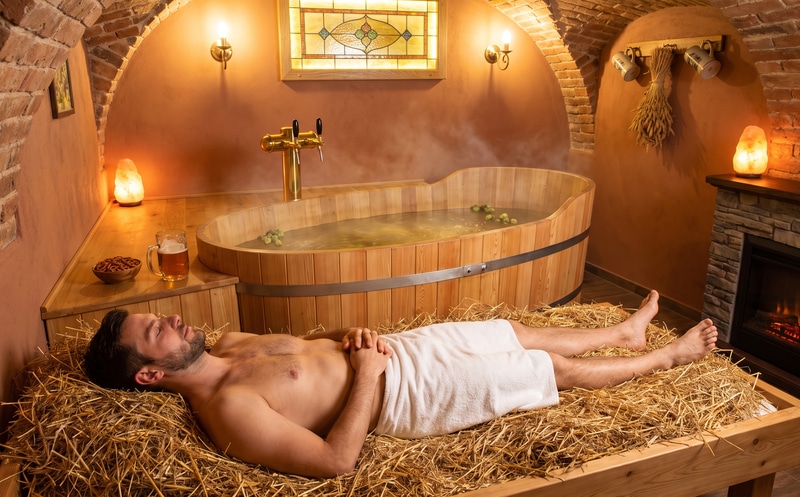
Every session at Lázně Pramen follows a defined structure. A standard procedure runs to roughly 90 minutes in total - around 20 minutes in the tub, with the remainder devoted to rest on a wheat-straw bed. That subsequent relaxation phase is important for muscle and joint recovery. Getting out of a warm bath, pulling on a coat and rushing for the tram surrenders much of the benefit. Staying still while the body settles keeps the muscles soft for longer and gives the whole experience a deeper restorative quality. The spa also recommends not washing off the beer or wine extract with soap for approximately two hours after the procedure, allowing the skin to remain supple and nourished.
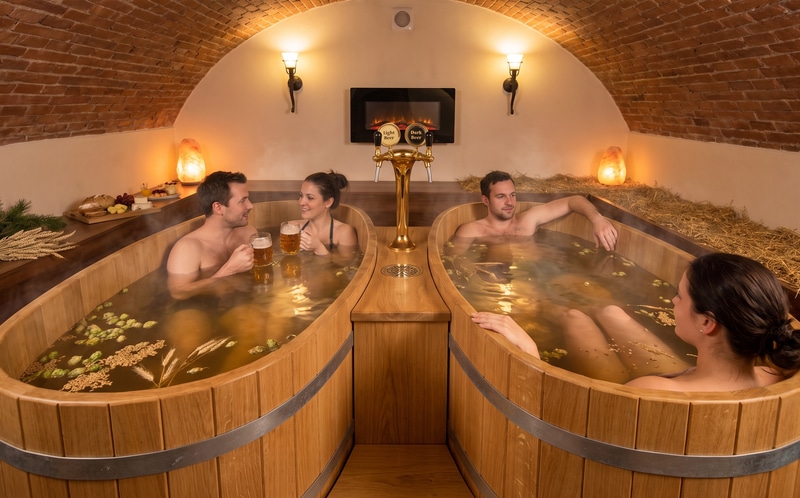
For a couple or a solo guest, the standard setting is Rubínový pramen, where both the beer bath and the wine bath take place in a single larch-wood tub with a whirlpool. If you would rather each person have their own tub - or if you are arriving as a group of up to four - Zlatý pramen is the logical step up. It is the only room that runs two tubs simultaneously. Two beer baths there start from €190 per booking; two wine baths from €268; and the beer and wine combination - one of each, side by side - from €238. As with all rooms, the price covers the room and configuration rather than the number of guests.
From a joint-comfort perspective, one further principle is worth keeping in mind: choose a procedure based on how you want to feel when you leave. Some people want the familiar, gentle rhythm of a warm soak followed by rest. Others want to build a longer ritual around the bath. The main thing is not to come expecting a medical outcome, but to use the visit as a considered tool for release and recovery - particularly during periods when the body is responding to cold weather, overwork or long sedentary stretches with increased stiffness.
Beer and wine baths as a recovery ritual
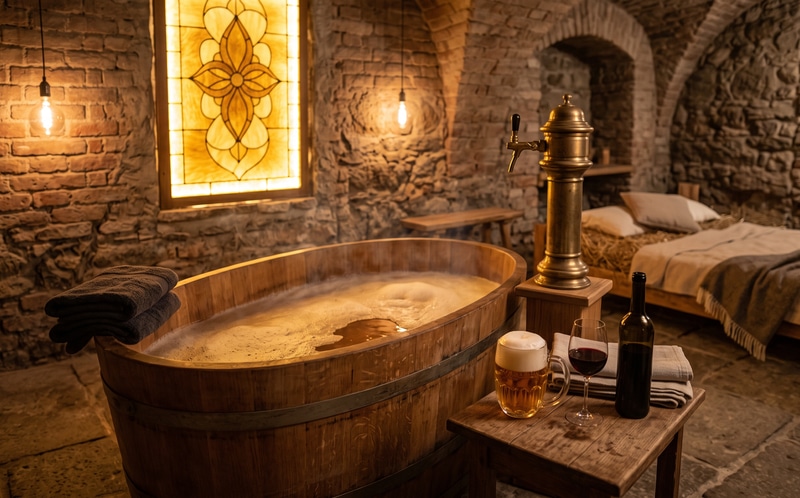
It is tempting to think that when it comes to joint comfort, water temperature is the only variable that counts. In practice, the broader ritual plays a larger role than that. The beer bath at Lázně Pramen draws on exclusive Czech craft beer, Petrovické zlato, together with Žatec hops, brewer's yeast and malt. The wine bath draws on red wine, grape seed extract, vine, honey, herbs and French lavender flowers. Neither formulation comes with a medical claim about treating joints. The point lies elsewhere: in the combination of warmth, privacy, an unhurried pace and a sensory experience that helps both the body and the mind shift from performance mode into recovery mode.
The psychological dimension of joint discomfort is consistently underestimated. Someone who lives with prolonged tension unconsciously braces their shoulders, alters their gait or compensates by favouring one side of the body - loading other structures in the process. When a person steps out of their ordinary routine for 90 minutes, the nervous system gets a real opportunity to stand down. That can matter surprisingly to how stiffness and pain are perceived. In that sense, both the beer and wine bath function as a form of guided rest - not passive in any deficient sense, but actively constructing the conditions for release. For many guests, the fact that the procedure takes place in a private room rather than a busy communal setting is itself a meaningful part of that.
For an intimate visit as a pair, Rubínový pramen with its single tub is the most popular choice. A beer bath there starts from €148 per room; a wine bath from €201. For more space, or for three or four guests, Zlatý pramen offers two oak tubs, a fireplace and a straw-bed rest area. There you can book two beer baths from €190, two wine baths from €268, or the beer and wine combination from €238 per visit. That last option works particularly well when two people have different preferences and neither wants to compromise on which bath they are sitting in.
For joints specifically, the key gift of this kind of ritual is that it slows things down. Slowing down is not a luxury add-on; it is a precondition for recovery. When the body stops bracing, the subjective sense of ease returns - and with it, often, a greater willingness to move afterwards. A spa visit is not the destination. It is a bridge between overload and a return to ordinary activity in a more comfortable state. That, precisely, is where its value lies.
Massage and the salt cave for the muscles around your joints
When joints cause problems, the issue is rarely limited to the joint itself. The surrounding soft tissue is almost always involved. Overloaded trapezius muscles compromise the neck and shoulders; tight glutes affect the hips and lower back; stiff calves and hamstrings alter the mechanics of the knee. Working on those soft tissues alongside the joint is therefore straightforward logic. At Lázně Pramen, that work happens through massage in Safírový pramen - a salt cave containing ten tonnes of salt, combining rock salt, Dead Sea salt and Himalayan salt. It is a distinct space from the bathing rooms, with its own quieter atmosphere suited to more considered procedures.
In the context of joint health, massage earns its place by reducing the muscular tension that limits freedom of movement at the joint. A relaxation massage suits those whose main problem is fatigue, desk-based overload, stress and a general sense of tightness - available as a 30-minute session from €33 or a 60-minute session from €50. For anyone who needs more intensive work after sport or sustained physical strain, a sports massage lasting 60 minutes is available from €75. Neither is a cosmetic extra. Both are practical tools for releasing the muscular armour around areas that tighten during the day and then limit comfort in movement.
Safírový pramen also offers pressotherapy - a mechanical lymphatic drainage treatment lasting 45 minutes from €23. The operational rules mean this cannot be booked in the same session as a bath, so it works best as a standalone appointment. For some guests, a mud or peat wrap may also be appropriate and can be arranged individually. The salt cave's broader appeal is the quality of its atmosphere: it feels genuinely separated from ordinary life, and that sense of separation meaningfully improves the chance that the body actually releases its tension rather than simply lying down with the same tightness it brought in from the car or the office.
The practical principle here is simple enough. If a bath is not what your body is calling for, but you feel stiff across the back, tight in the neck or heavy in the legs after exercise, start with a massage. If you want a more comprehensive session, the full range of options is laid out on the all procedures page, where you can match the format to your current physical state. Joint care is rarely about one problem in one place. It is about the whole movement chain - and a well-chosen massage has a very practical role in that.
The V.I.P. ritual when you need longer
Sometimes a ninety-minute stop is not enough. The body is depleted, the head is overloaded, and what is needed is a longer, uninterrupted block of recovery. That is the purpose of Smaragdový pramen, the only V.I.P. room at Lázně Pramen. It accommodates one or two guests and combines a larch-wood tub with a whirlpool, a fireplace, a wheat-straw rest bed and a cedar fitobochka. That last element is worth noting from a joint-comfort perspective: it is a compact cedar cabin in which the body is enclosed but the head remains outside - quite different from a Finnish sauna. It is a specific warming element that forms part of the V.I.P. ritual and prepares the body for what follows.
The V.I.P. Beer SPA starts from €293 per booking for one to two guests and runs for approximately two and a half to three hours. The sequence includes 15 minutes in the cedar fitobochka, then a relaxation massage or scrub lasting 20-30 minutes, followed by a beer bath and rest by the fireplace. Unlimited light and dark beer with a snack is included in the price. The V.I.P. Wine SPA starts from €326 per booking, follows the same duration and structure, but builds around the wine bath and includes a bottle of wine and a fruit and cheese board. For someone managing joint stiffness alongside broader exhaustion, the extended timeframe is often the most significant factor. The body does not switch into rest mode in five minutes.
There is also a Deluxe Wine SPA from €326, designed for a single guest. This is the most thorough and sustained of the formats: cedar fitobochka, a 20-minute wine scrub, a 40-minute wine wrap, a 40-minute full-body massage with grape seed oil and a rest period at the end. It is also the only package that includes a bathrobe. From a muscular and joint-comfort standpoint, what makes this format distinctive is that it does not rush from one stimulus to the next. Everything happens in the same space at the same pace, which tends to produce a deeper release.
One practical point: V.I.P. procedures are not group formats. Smaragdový pramen is reserved for one or two guests, making it the right choice for a couple or an individual rather than a team outing. If you are looking at spa as part of a joint-care approach and you know a standard bath will not give you enough time, this room is the most logical option. A longer recovery session sometimes delivers more than a more intense one.
Choosing a visit based on what your body actually needs
The real question is rarely beer versus wine versus massage. It is: what do you need from this visit, and what state are you arriving in? If the main issue is general stiffness, fatigue from sitting or the desire for a quiet evening as a couple, the most practical starting point is usually a standard beer bath or wine bath in Rubínový pramen. A single tub, an intimate atmosphere, minimal decisions and a clear sequence of bath followed by rest. Beer from €148 per room, wine from €201. Because pricing is per booking rather than per person, this works well for a couple sharing the same space and the same tub.
If you and your companion have different preferences, or simply do not want to share a tub, Zlatý pramen resolves the dilemma. It is the only room with two separate oak tubs, which means one guest can choose a beer bath while the other opts for the wine bath - the beer and wine combination from €238 per room. Alternatively, you can book two beer baths from €190 or two wine baths from €268. This works just as well for small groups of up to four as it does for couples. From a joint-care perspective, it is particularly useful when you want to share the visit while keeping your individual choice of procedure and having enough room to properly unwind.
If stiffness comes alongside real fatigue, significant muscular overload or a need for a more complete reset, move straight to Smaragdový pramen. V.I.P. Beer SPA from €293 and V.I.P. Wine SPA from €326 both add the cedar fitobochka and a massage or scrub to the core bath, making the visit a sequence of layered steps rather than a single procedure. Conversely, if a bath is not what you are after right now and you feel predominantly tight across the back, the neck or the legs after exercise, the smarter move is to begin with a massage in Safírový pramen: relaxation at 30 minutes from €33, 60 minutes from €50, or sports at 60 minutes from €75.
The right visit is not the most expensive one, nor the longest. It is the one that fits your body's current state. Joint care is a long game, which means choosing procedures with some intelligence rather than maximum ambition. Sometimes the ideal visit is a shorter bath every few weeks; sometimes a longer ritual; sometimes a targeted massage and nothing more. The measure of a good session is simple: you should leave feeling better, not worn out by the effort of recovery itself.
What to do before and after your visit
A successful spa visit does not begin the moment you step into the tub. A good deal depends on how you approach the session beforehand and what you do in the hours that follow. If your aim is to support joint comfort and reduce stiffness, arriving without time pressure makes a real difference. A body that has sprinted up the stairs at the last moment carries its tension into the relaxation space with it. The practical advice is to arrive with some time in hand, avoid coming on a full stomach and avoid booking a demanding evening immediately afterwards. Lázně Pramen is at Dejvická 255/18 in Prague 6, roughly two minutes on foot from Hradčanská metro station - a logistically easy destination, particularly for guests who do not want to navigate across the city after an evening session.
It is also worth bearing in mind that the effect of warmth does not stop at the door. After a beer bath or wine bath, giving the body a little extra quiet time pays dividends. A slower pace home, avoiding immediate exposure to the cold - these are small things that help maintain what the session has created. Every room has a shower, but the recommendation is to avoid washing off the extract with soap for approximately two hours after the procedure, so the skin stays smooth and nourished into the following day. In the context of joint care, the extended rest after the bath supports a broader state of relaxation that is worth protecting. A quiet evening after the visit keeps the body in recovery mode noticeably longer than an immediate return to activity.
It also helps to think of a spa visit as one part of a wider pattern rather than the whole of it. A spa works best when it is not the single island of care in an otherwise chaotic week. Anyone managing joint stiffness over the long term should pair spa visits with the everyday fundamentals: movement that stays within the body's current tolerance, varying positions during desk work, sensible load management and adequate sleep. Lázně Pramen fits into that framework as a high-quality complement - a reliable way to help the body shift gears - but it does not replace daily habits. Saying so is not a caveat; it is the basis for realistic expectations, which in turn is the basis for genuine satisfaction.
If you are unsure which option suits you best, the full procedures overview is a practical place to start, or you can reach the team directly through the contact page. Bookings are made online through the reservations page. And if you want to give joint care and recovery as a gift, gift vouchers are available with a twelve-month validity - the recipient chooses the procedure themselves, according to their own preferences and how their body feels at the time.
Spa as part of a longer-term care approach
The most common mistake in joint care is expecting a single visit to change everything. Lasting movement comfort is usually built from smaller, consistent steps: movement that does not overload the joints, work on muscular strength, a reasonable bodyweight, sufficient sleep and - crucially - regular intervals in which the body is given the space to recover. That is where spa belongs. Not as an annual reward, but as a consciously scheduled restorative tool. People who approach it that way tend to stop chasing dramatic promises and start noticing something more useful: less morning stiffness, better rest, a calmer mind and an easier return to their ordinary rhythm.
At Lázně Pramen, privacy is one of the defining practical advantages. Public wellness environments can be too loud, too busy or simply too much effort for a section of guests - particularly those for whom joint discomfort already makes the world feel effortful enough. A private room removes those frictions and allows the session to unfold at your own pace. Whether you choose Rubínový pramen for an intimate beer bath from €148 or wine bath from €201, the more spacious Zlatý pramen with two tubs from €190, or a longer ritual in Smaragdový pramen from €293, the common thread is time without external demands. That, in regeneration, is often more valuable than any specific detail of the treatment itself.
The breadth of the offering also matters over time. Some guests return consistently for the bath; others come primarily for the massage in Safírový pramen; others rotate between the two depending on the season and the load they have been carrying. In winter the warmth of a bath tends to be what the body asks for; after a heavy sporting or working period, targeted muscular work takes precedence. That kind of flexibility is genuinely useful in a long-term joint-care approach, because it respects the fact that the body's needs shift. Sometimes more heat is right; sometimes more manual release; sometimes simply more time lying still.
One final note: if you are managing a health condition and are unsure whether a particular procedure is suitable, your doctor has the last word - and the relevant operational guidelines are available on the terms and conditions page. For the majority of people seeking gentle recovery from stiffness, fatigue and the accumulated strain of an ordinary busy life, though, a well-chosen spa visit is a sensible and civilised way to complement regular self-care. Not through promises of a cure, but through a considered environment built for ease and rest.
Sources
- Mayo Clinic - heat and cold therapy for arthritis - www.mayoclinic.org
- PubMed - aquatic exercise for musculoskeletal conditions: a meta-analysis - pubmed.ncbi.nlm.nih.gov
- Harvard Health - heat or ice for arthritis pain? - www.health.harvard.edu
- NCCIH - rheumatoid arthritis and complementary health approaches - www.nccih.nih.gov
- Versus Arthritis - heat and cold treatments - versusarthritis.org