Why grapes became a beauty headliner
Vines have kept us company for thousands of years, and for most of that time we valued them for one thing only: what ends up in the glass. It took modern chemistry to reveal that the real treasure hides in the places we rarely look - the skins, the seeds and the leaves. These parts of the grape are dense with polyphenols, natural compounds the plant deploys as its own defence system against sun, mould and oxidative stress. Those same properties are exactly what make grapes such an intriguing raw material for the face and body.
Vinotherapy - the use of wine and its components in cosmetics and spa culture - rests on a simple idea: what protects the vine may well help our skin. Grape-seed extract and grape-seed oil rank among the most prized ingredients in natural skincare. The skins of red grapes carry resveratrol, one of the most heavily studied plant antioxidants of recent decades. Add tannins, flavonoids and vitamins, and you get a cocktail that dermatology talks about with genuine respect.
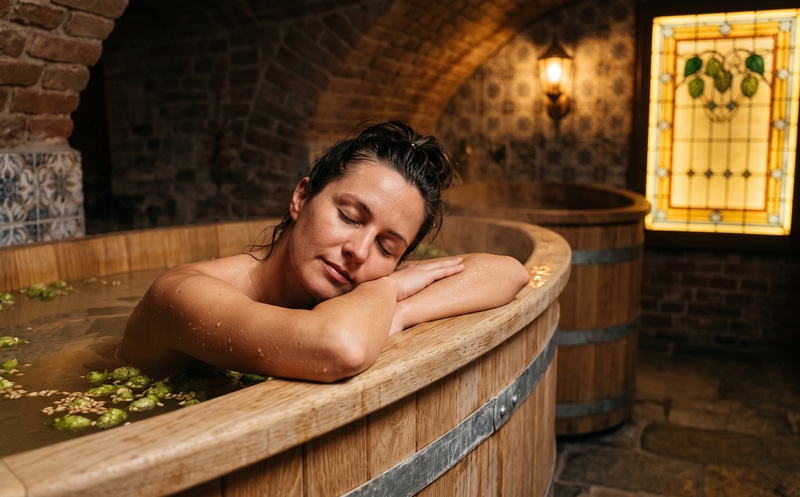
In our private rooms in Dejvice this is neither a marketing flourish nor a few drops of perfume. Into the wine bath we add, in front of you, red wine, grape-seed extract, a vine leaf, honey, herbs and the blossoms of French lavender. The active compounds reach your skin not from a tube but straight from a bath held at 35-38 °C, when pores are relaxed and the skin is ready to receive. This article sets out what polyphenols and resveratrol really do, where their limits lie, and how to try wine care for yourself - no inflated promises, no fiction. For the chemistry in more depth, read our scientific guide to resveratrol in the wine bath and our piece on why grapevine has earned a lasting place in Czech skincare.
Resveratrol: the antioxidant that guards the vine and calms the skin
Resveratrol is a stilbenoid, a natural phenolic compound the vine produces mainly in the skins of red grapes as a stress response - to a fungal attack, to damage, to intense sunlight. The plant is quite literally saving its own life, and that is precisely why resveratrol behaves as such a powerful antioxidant. In the skin, antioxidants have a clear job: they help neutralise the free radicals generated by UV exposure, pollution and ordinary cellular ageing.
The scientific literature has long studied resveratrol in exactly this context - protecting the skin from oxidative stress and supporting its natural resilience. Research suggests it can dampen the chain reactions that break down collagen and elastin, the structures on which the firmness and elasticity of skin depend. That is why it turns up in so-called anti-ageing cosmetics, paired not with miracle claims but with a sober premise: protected skin ages more slowly than skin left exposed to oxidative stress.
Honesty matters here. Resveratrol is not a medicine, and no cosmetic can turn back the clock. What good antioxidant-based care can do is support the skin's own processes, soothe irritation and improve overall appearance. In the setting of a wine bath, the point is not to dose yourself with resveratrol like a pill but to spend time in a sensory, comfortable environment where the skin is warmed by water at 35-38 °C and surrounded by natural grape extracts.
Interestingly, resveratrol works best alongside other polyphenols rather than in isolation. This is exactly why a whole natural ingredient - the entire grape, its skin, seed and leaf - makes more sense than a single synthetic molecule. The vine offers a full spectrum of mutually reinforcing compounds, and that principle underpins our wine treatments too.
Polyphenols and grape-seed extract: the power tucked into seeds and skins
Resveratrol is the famous one, but it is far from the only treasure the vine offers. Grape seeds contain proanthocyanidins, a group of polyphenols with striking antioxidant capacity, and they are also the source of a light, delicate oil rich in linoleic acid. Grape-seed oil is prized in cosmetics for its texture: it absorbs well, leaves no greasy film and suits even oil-prone skin, which many heavier oils overwhelm.
In the technical literature, grape polyphenols are linked to several desirable qualities at once. They act as free-radical scavengers, support microcirculation in the skin and help calm it. That is why grape-seed extract shows up in serums, creams and body oils aimed at mature or tired skin. Combined with the B-group vitamins that occur naturally in other parts of the vine, the result is care that protects and nourishes in equal measure.
In our wine bath we work to exactly this logic of the whole. We do not add a single isolated compound; we add a complex blend: red wine, grape-seed extract, a vine leaf, honey, herbs and the blossoms of French lavender. Honey softens, herbs and lavender bring calm and a lovely scent, and the vine leaf contributes further plant polyphenols. The result is a bath that works on the skin comprehensively rather than at one point.
For clarity, here is what each ingredient of the bath offers the skin:
- Red grape skins: resveratrol and other antioxidants that shield against oxidative stress.
- Grape seeds: proanthocyanidins and a light, nourishing oil suitable even for combination skin.
- Vine leaf: additional polyphenols and plant tannins.
- Honey: natural softening and support for skin hydration.
- Lavender blossom and herbs: calm and the sensory pleasure of the bath.
It is this combination that separates genuine vinotherapy from simply tipping wine into water.
The wine bath in practice: beauty care, live
Theory is all very well, but skin needs the experience itself. Our wine bath lasts a full 90 minutes and follows a clear shape: roughly 20 minutes in a bath at 35-38 °C with an automatic whirlpool, then about 50 minutes of rest on a heated bed of wheat straw. That resting phase is where much of the beauty benefit lies - in the warmth and stillness the skin keeps absorbing the active compounds while the whole body unwinds.
We add the natural blend to the tub every time in front of you: red wine, grape-seed extract, a vine leaf, honey, herbs and the blossoms of French lavender. For one or two people in a single tub, the wine bath starts at 201 EUR per room - not per person - with a bottle of wine and a platter of fruit and cheese included. Come as a pair and you split the cost, which makes the wine bath an unexpectedly accessible luxury.
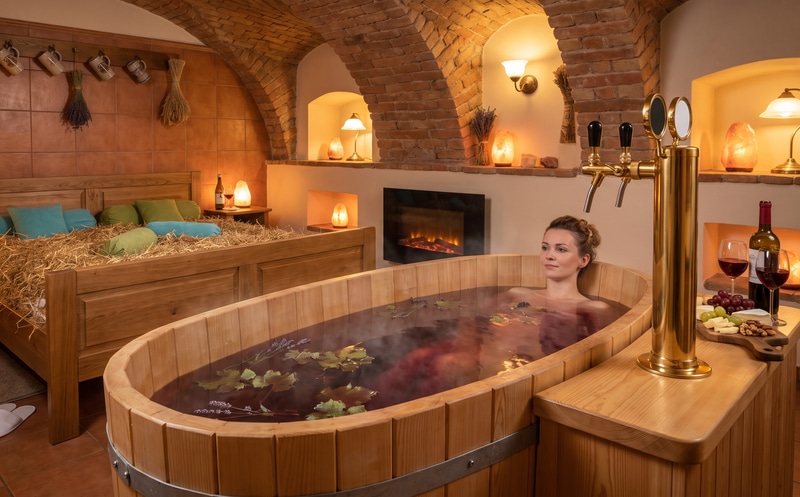
The most intimate setting is Ruby Spring (Rubínový pramen), a snug room with a single larch tub and whirlpool, an electric fireplace and a heated straw bed. For two to four people there is Golden Spring (Zlatý pramen) with two oak tubs - the only room where two wine tubs can run at once (from 268 EUR per booking). If you want to go further still, you can choose a combination of wine and beer in two tubs side by side.
The mood comes from the warmth of the water, the heated straw bed, the soft glow of the lamps and the flicker of the electric fireplace. No open flame, no candles - just a safe, calm, sensory space in which skin and mind alike are pampered. The wine bath, in other words, is less a cosmetic procedure than a small ritual of beauty.
V.I.P. wine rituals for the most demanding care
If 90 minutes will not do and you want to draw the most from grape polyphenols, your route leads to Emerald Spring (Smaragdový pramen). This V.I.P. room is the only one where our premium packages take place, bringing together a larch tub with whirlpool, a cedar phyto-sauna (a Siberian cedar barrel), an electric fireplace and a heated straw bed. The cedar phyto-sauna, a small barrel that encloses your body while your head stays outside, is part of an experience an ordinary bath simply cannot offer.
The V.I.P. Wine SPA for one to two people runs two and a half hours and starts at 326 EUR per booking. The programme moves from the cedar phyto-sauna through a relaxation massage or peeling to the wine bath itself and a closing rest. A bottle of wine and a platter of fruit and cheese are included, so skincare meets gastronomic pleasure. The pairing of heat from the cedar barrel, warmed skin and the wine bath that follows creates ideal conditions for grape polyphenols to do their best work.
The most exclusive is the Delux Wine SPA, reserved for a single guest and likewise starting at 326 EUR. It includes the cedar phyto-sauna, a wine peeling, a wine wrap, a full-body massage with grape-seed oil and a final rest by the fireplace with a glass of wine and a cheese platter. Alone among our packages, it comes with a bathrobe. The grape-seed oil massage is the pinnacle of wine cosmetics applied directly to the body - the fine seed oil is worked into warmed skin, topping it up with light, readily absorbed nourishment.
These rituals are designed as an intimate experience for an individual or a couple, not as a programme for a large group. Anyone after genuinely luxurious beauty care on the border between spa tradition and cosmetics will find it here. An overview of all our procedures will help you pick the version that fits.
Our own beer cosmetics to take home
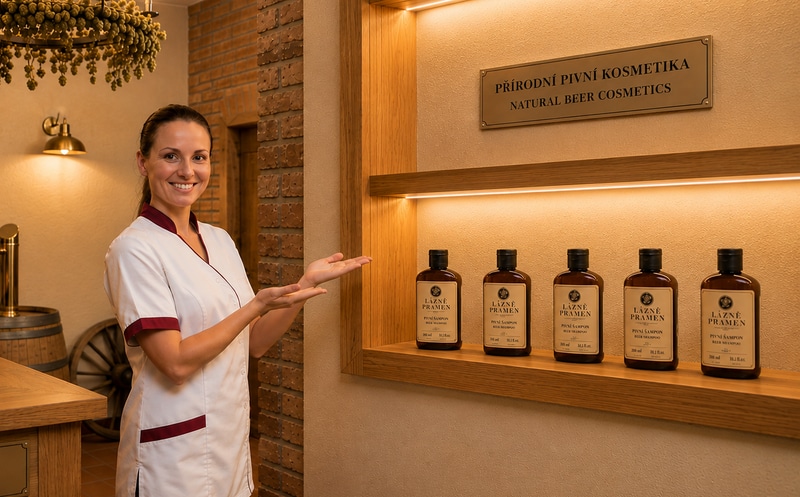
At our spa, wine cosmetics are something you experience during a treatment, not something you buy in a jar. The Delux Wine SPA brings them together in one programme: a 20-minute wine peeling, a 40-minute wine wrap and a 40-minute full-body massage with grape-seed oil. What you can take home is our own range of beer cosmetics, which we make ourselves and sell at reception. It is deliberately focused, with exactly five products: a beer shampoo, a hair conditioner, a body peel, a body scrub and a bath salt.
The body peel and body scrub help lift away dead cells and prepare the skin to receive whatever care follows. Regular gentle exfoliation is a step many people underrate, even though it has a real effect on how smooth and radiant the skin looks. The bath salt, meanwhile, lets you bring part of the spa ritual home - to your own tub, in the moments you want a little quiet.
Hair is covered too, with the beer shampoo and hair conditioner. For the full beer experience, though, there is the beer bath itself.
One more rule helps you get the most out of spa care. After both the wine and the beer bath we recommend leaving the extracts on your skin for about two hours before washing them off with soap. A shower is available in every room, but if you let the active compounds keep working, your skin stays softer and better nourished for a day or two.
Who wine care suits, and what to keep in mind
Vinotherapy and care built on grape polyphenols suit a wide range of people. Most often they are sought out by those wanting to support mature or tired skin, by those who feel their skin needs calming and brightening, or simply by anyone after a sensory beauty ritual that pairs body care with deep relaxation. The antioxidant properties of grape extracts make sense as part of a long-term strategy - protecting the skin from oxidative stress rather than waiting for a miracle from a single application.
A wine bath also makes a wonderful gift. If you want to treat someone who rarely indulges in a little self-care, reach for a gift voucher. It is valid for 12 months and lets the recipient choose when and which procedure to enjoy - from a wine bath to a V.I.P. ritual or a massage in the salt cave.
The principle of honesty holds throughout. Wine cosmetics and baths are about beauty and relaxation, not treatment. Our baths and massages are not suitable for everyone - a full list of contraindications appears in our terms and conditions, in article 9. If you have any doubt about your health, or know you are sensitive to one of the bath's ingredients such as wine extracts, herbs or lavender, seek advice beforehand and, if need be, opt for a different service.
For those who want beauty care without stepping into a tub, there is Sapphire Spring (Safírový pramen), a salt cave holding ten tonnes of salt where massages start at 33 EUR for 30 minutes, alongside other procedures amid the salt walls. That too is a form of care for body and wellbeing, complementing what vinotherapy offers. Whatever you choose, the goal stays the same - skin that looks better and a mind that gets to rest.
How to book your wine care, and when to come
Booking is straightforward. Choose your date, the number of guests and the type of bath in the reservation form right here on the site - just open the booking page and follow the online flow, which guides you step by step. If you are unsure which version to pick, or have a specific request, get in touch via our contact page and we will gladly advise.
You will find us at Dejvická 255/18, Prague 6 - Dejvice, a mere two-minute walk from Hradčanská metro station. We are open on weekdays from 10:00 to 22:00 and at weekends from 10:00 to 23:00, so you can enjoy a wine bath as an evening wind-down after a demanding day or as a weekend ritual for two.
Before you arrive, a few practical tips help. Come with a little time to spare, so you can change and settle in unhurried. Avoid a heavy meal beforehand and drink plenty of water, since a warm bath at 35-38 °C heats the body. Afterwards, remember our advice: leave the wine extracts on your skin for around two hours before washing them off with soap, so the skin stays supplied with polyphenols and soft for as long as possible.
For a quick overview, here are the most common versions of wine care and their starting prices per booking (not per person):
- Wine bath for 1-2 people in one tub: from 201 EUR per room, a bottle of wine and a fruit-and-cheese platter included.
- Two wine tubs at once for 2-4 people in Golden Spring: from 268 EUR.
- V.I.P. Wine SPA for 1-2 people in Emerald Spring: from 326 EUR.
- Delux Wine SPA for a single guest, bathrobe included: from 326 EUR.
- A gift voucher for any procedure, valid for 12 months.
Whether you choose an intimate bath for two or a lavish V.I.P. ritual, wine beauty care is ready and waiting. Just pick a date and let the grape polyphenols get to work.
Sources
- Resveratrol as a factor preventing skin aging and affecting its regeneration - pmc.ncbi.nlm.nih.gov
- Skin photoprotection by natural polyphenols: anti-inflammatory, antioxidant and DNA repair mechanisms - review, Archives of Dermatological Research 2010 - pubmed.ncbi.nlm.nih.gov