Why one number on the thermometer matters so much
Say the word spa and most people picture water as hot as they can stand: steam rising off the surface, a slow descent with clenched teeth. It is a deeply ingrained image, and it is also wrong - at least when you look at what a bath actually does to the body and the skin. In our private rooms we keep the water deliberately between 35 and 38 °C, and that figure is not a footnote. It is one of the defining decisions behind the whole experience. Temperature dictates how long you can stay in the tub, how you feel when you step out, whether your head aches, how your skin responds, and how much of the good stuff from hops, malt, yeast or wine you actually carry home with you.
The 35 to 38 °C range is neither accidental nor a marketing flourish. It hovers just above body temperature. That means your body does not have to spend energy defending itself against the water, nor does it overheat inside it. The water holds you rather than shocking you. This is precisely the band in which the muscles let go, the breathing slows, and the mind finally quietens - which is the entire point of a beer bath and a wine bath alike.
In this article we explain what happens inside the body at this temperature, why hot water paradoxically gets in the way of relaxation, how temperature relates to the health of your skin barrier, and why a gently warm soak opens the skin to active ingredients better than anything hotter. This is not theory for its own sake. It is the reason we build our spa exactly the way we do, and the reason a visit runs 90 minutes in the room - about 20 of them in the tub, the rest of the time spent resting on a heated straw bed. Temperature and time work hand in hand.
What gentle warmth does to the body and circulation
Lower yourself into water at around 37 °C and a cascade of pleasant physiological reactions begins. The blood vessels near the surface of the skin dilate, blood flows more freely to the extremities and to the skin itself, and the small tensions that build up over a day start to ease. That dilation is closely tied to the sense of warmth and lightness that lingers after the bath. At the same time the hydrostatic pressure of the water - the simple fact that you are submerged - massages the tissues gently and helps blood and lymph return to the heart. It is why 20 minutes in the water can leave you feeling as though you had rested far longer.
A warm bath also has a well-documented relationship with sleep. The evidence points the same way again and again: a warm soak in the late afternoon or evening helps the body slip more easily into rest mode. The mechanism is elegant. Warming the surface of the body dilates the vessels, so once you climb out, the body sheds excess heat into the room more quickly and the core cools slightly. That drop in core temperature is one of the signals telling the body it is time to sleep. Water at around 37 °C triggers this reliably without ever overheating you.
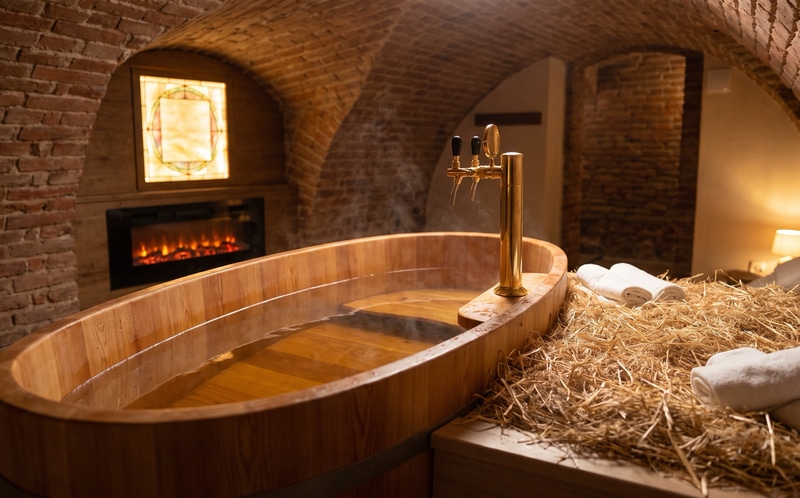
This is why every bath room pairs the tub with rest on a heated straw bed, in the soft glow of an electric fireplace. It is not merely a romantic backdrop; it is a working part of the treatment. As you rest, the body finishes what the bath began: temperature slowly evens out, circulation settles, and you leave with a calm that stays with you. The shape of a visit is no accident either: the room is yours for 90 minutes, of which about 20 go on soaking, up to 30 if you feel like staying in longer, and the rest belongs to the straw bed - the same for a beer bath and a wine bath alike. It matches how the body genuinely responds to warmth. Heat the water higher and we would have to shorten your time in it - which is exactly what we want to avoid.
Why not a scalding bath, just to feel it properly
The logic of "the hotter the better" simply does not hold for a bath. Once the water climbs well above body temperature it stops being relaxing and starts being a burden. A hot bath forces the heart to work faster, the pulse rises, and the body has to fight actively against overheating. Instead of a pleasant release, you get lethargy, dizziness on standing, and for the more sensitive among us, a headache. What should be rest turns into a small feat of endurance that leaves the body drained rather than refreshed.
Overheating the core is no trivial matter, either. When the water sits more than a few degrees above body temperature, the body can no longer keep pace with cooling itself and its internal temperature begins to rise. In the short term that means dizziness and a pounding heart; over a longer stay in genuinely hot water it can put real strain on the circulatory system. Every serious spa therefore works to a sensible upper limit. Ours is 38 °C, and we do not go above it.
There is a practical reason too, bound up with what we actually offer. For a beer bath or a wine bath to do its job, you need to spend enough time in the water - about 20 minutes with us, up to 30 if you like, during which hops, malt, yeast, or extracts of grape, honey and herbs work on the skin. In hot water you simply could not last that long, and you would have to climb out before the active ingredients had a chance. Gently warm water lets you stay submerged for the whole treatment, comfortably and without effort. So 35 to 38 °C is not a compromise; it is the setting that makes the whole thing meaningful. Anyone after an even longer ritual with a cedar phyto-sauna will find it in our V.I.P. room Emerald Spring (Smaragdový pramen), where the treatment runs for two and a half hours.
Temperature and the skin barrier: why heat dries you out
The surface of the skin is protected by what dermatologists call the skin barrier - a thin layer of dead cells held together by lipids, or fats, working rather like a brick wall bound with mortar. This layer keeps moisture in and irritants out. It has a great deal to do with whether your skin feels supple and plump after a bath, or tight, dry and irritated instead. And the temperature of the water decides how kindly the bath treats that barrier.
Hot water dissolves skin lipids much as it lifts grease off dishes. The higher the temperature, the more of the skin's natural oils it washes away, the more it disrupts that protective layer, and the more likely you are to feel tightness, itching or dryness afterwards. Dermatology sources have long recommended washing and bathing in lukewarm rather than hot water, especially for anyone with sensitive, dry or atopic skin. A short soak in gently warm water leaves the barrier largely undisturbed, and the skin comes out soft.
Our 35 to 38 °C range is chosen with the skin in mind, too. It is warm enough to relax the pores and the skin's surface so the active ingredients can get to work, but not so hot that it needlessly strips the lipids. To that we add one important tip that changes the outcome: after the treatment, do not wash with soap - leave the beer or wine extract on the skin to keep working for about two hours. Your skin stays softer and better nourished for a day or two after the visit. Anyone who wants to carry the care on at home can pick up our own beer cosmetics at reception - beer shampoo, hair conditioner, body peeling, body scrub and bath salts. It is exactly this combination of gentle warmth, unhurried time in the tub and considerate aftercare that makes a visit something the skin genuinely notices.
How we hold the temperature and why we build your bath in front of you
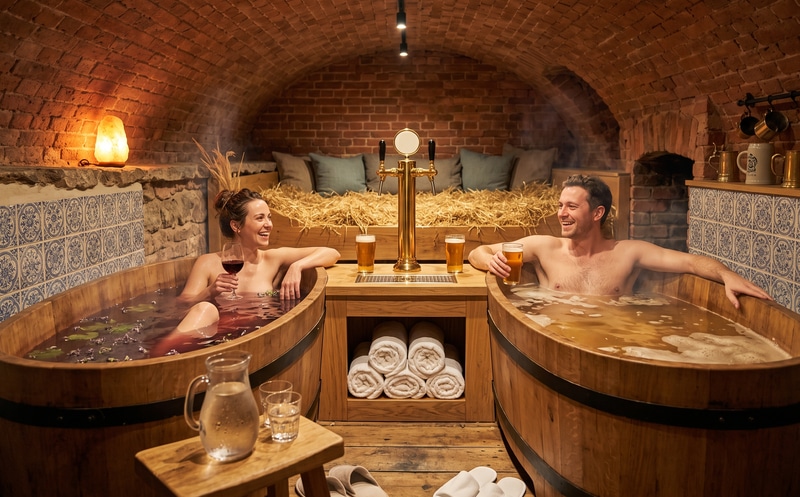
A temperature that sounds simple on paper takes real care in practice. We do not run the water ahead of time and leave it waiting to go cold. Every bath is prepared fresh, right in front of you, and only then do we add the natural blend - real craft beer, Žatec hops, yeast and malt for a beer bath, or red wine, grape-seed extract, vine leaf, honey, herbs and French lavender flowers for a wine bath. That way we know you are stepping into water at the right temperature and at the full strength of its active ingredients, not into something that has been stewing in an empty tub for two hours.
Our tubs are wooden and hand-built, which helps hold the temperature all on its own - wood is a natural insulator and does not cool as fast as metal or plastic. Each tub also has automatic whirling that stirs the water gently, keeps the temperature even throughout, and distributes the active ingredients as it goes. There are none of the cold and hot pockets you know from an ordinary bath at home, where the water is scalding by the tap and lukewarm at your feet.
The 35 to 38 °C range also makes practical sense depending on who arrives. Some people prefer the lower end, around 35 °C; others find 38 °C more agreeable - and within that band we can adapt. Whether you choose the intimate Ruby Spring (Rubínový pramen) for one or two guests, the spacious Golden Spring (Zlatý pramen) with two tubs for up to four, or the V.I.P. Emerald Spring, the temperature philosophy stays the same. The water should be pleasant from the first minute to the last, not a test of endurance. And because every room has its own tub with whirling, we set the temperature individually for each booking.
When the answer is not water: salt, massage and another path to calm
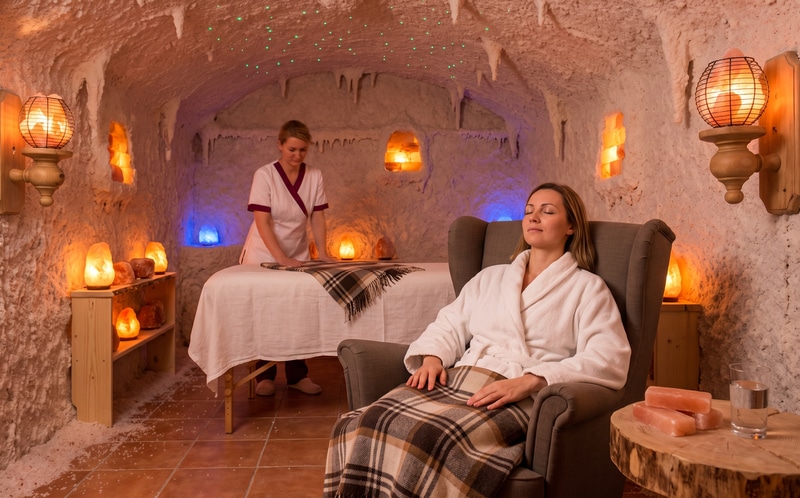
Not everyone comes to soak, and not every body is in the mood for warmth on a given day. That is why we also have a room with no tub at all, one that works quite differently - Sapphire Spring (Safírový pramen), our salt cave. Ten tonnes of salt of three kinds - rock, Dead Sea and Himalayan - form the walls of a space given over to massages and other treatments. The air here is dry and salty, the mood calm, the temperature undemanding. For anyone who does not particularly seek out heat, or for whom heat is unwelcome for any reason, it is a full-fledged alternative.
In the salt cave we offer relaxation and sports massages. Both relaxation massages work the whole body: 30 minutes from 33 EUR per guest, or 60 minutes from 50 EUR per guest when you would rather nothing was rushed. A sports massage lasts 60 minutes from 75 EUR per guest and goes deeper, into tight muscles, problem areas and recovery. You can book a massage on its own, or have one before a bath: with us the massage always comes first and the tub follows, never the other way round.
Pairing a bath with a massage in a single visit has a logic all its own, and it lies in the order: the massage comes first, the tub after it, never the other way round. Our V.I.P. programme is built exactly that way - cedar phyto-sauna, then a relaxation massage or a peeling, then the bath, then the straw bed. Anyone wanting a fuller evening therefore starts with a massage in Sapphire Spring and moves to the tub afterwards, so that nothing follows the water except rest. So whether you are after warmth, salt or both, the path to relaxation is not tied to a single water temperature - but if you do choose the water, ours will always be pleasantly warm rather than punishingly hot.
Who a gently warm bath suits best
A gently warm bath in the 35 to 38 °C band is one of the reasons our spa is open to such a wide range of guests. Precisely because the water does not overheat you or push the circulation beyond a sensible point, it is a pleasant, undemanding experience for most healthy adults. It appeals to people after a heavy day at the office, after sport, after long-haul travel, and to anyone who simply wants to give themselves an evening for two that they will remember. A couple can slip into the tub in Ruby Spring, while a larger group of up to four can use the two tubs in Golden Spring.
Gentle warmth is especially welcome for those with sensitive or dry skin who tolerate hot water poorly. The kind temperature, combined with our tip not to wash with soap for about two hours afterwards, makes the experience friendly even for more demanding complexions. Even so, a bath is not right for absolutely everyone. You will find the full list in our terms and conditions, article 9, and if you have any doubt at all, we recommend consulting a doctor before booking.
If you are not sure whether a visit is right for you, or you want to give the spa as a gift without choosing a date on someone's behalf, we have a solution. A digital gift voucher lets the recipient redeem it against a treatment of their own choosing, on a date that suits them. We are also glad to answer any question in advance - just get in touch and we will talk through what fits your situation best.
How to book the experience at the ideal temperature
Booking is simple, and the whole thing takes a few minutes online. Through the booking widget on our website you choose the type of treatment, the number of guests, and your date and time. The price of a bath is always calculated per room, or rather per booking, never per person: one figure covers the whole visit, whether you come alone or as two sharing a single tub. Where two tubs run side by side, that figure follows the size of the party. That is worth knowing as you plan the budget for the evening.
One or two guests sharing a single tub pay from 148 EUR for a beer bath and from 201 EUR for a wine bath, usually in the intimate Ruby Spring, the wine option coming with a bottle of wine and a platter of cheese and fruit brought to the room. Golden Spring takes two tubs at once, and there the number of guests decides: two beer tubs from 190 EUR for two guests, 242 EUR for three and 283 EUR for four; two wine tubs from 268 EUR for two, 354 EUR for three and 367 EUR for four; and the popular combo, one tub of beer and one of wine side by side, from 238 EUR for two, 278 EUR for three and 307 EUR for four. Anyone longing for the most complete ritual heads to the V.I.P. Emerald Spring, where the treatment lasts two and a half hours and includes a cedar phyto-sauna - the V.I.P. Beer SPA from 293 EUR and the V.I.P. Wine SPA from 326 EUR, both for one or two guests.
Whichever version you choose, the water temperature of 35 to 38 °C remains the common thread. It is a setting we chose on purpose, and it is why you leave our spa relaxed and with soft skin rather than overheated and worn out. You will find the complete list of treatments on our menu page, you can make the booking itself on the booking page, and for anything else just write to us via our contact page. We are open weekdays from 10 am to 10 pm and weekends from 10 am to 11 pm - we look forward to seeing you.
Sources
- Journal of Clinical Medicine - Impact of water exposure and temperature changes on skin barrier function - pmc.ncbi.nlm.nih.gov
- National Eczema Association - Bathing and eczema - nationaleczema.org
- American Academy of Dermatology - Dermatologists' top tips for relieving dry skin - www.aad.org
- Cleveland Clinic - How to tell if your skin barrier is damaged - health.clevelandclinic.org
- Sleep Medicine Reviews - Before-bedtime passive body heating by warm shower or bath to improve sleep - pubmed.ncbi.nlm.nih.gov